
The Experience Illusion: Why Today's Best Leaders Are Trapped By Their Own Success


Author Aravind Sakthivel explains why experience can become a leadership liability and how AI is exposing outdated management models.
By Jessica Williams
For decades, the business world has operated under a simple, uncontested rule: experience is a leader's greatest asset. It sharpens judgment, accelerates decision-making, and serves as a reliable compass during market turbulence.
But what happens when that compass points toward a landscape that no longer exists?
In his book The Leadership Trap: Why Smart Leaders Fail and How to Break Free, published in February 2026, technology executive Aravind Sakthivel challenges that assumption. He has held IT leadership roles at global industrial organizations, and he argues that the very experience that propels leaders to the top can become the anchor that drags them down. The book, which he summarizes as "6 Traps, 3 Systems, and One 90-Day Escape Plan," examines six recurring patterns that pull capable leaders off course.
I sat down with Aravind to discuss how successful operating models quietly breed rigidity, why enterprise AI is exposing outdated management styles, and how leaders can turn hard-earned experience from a restrictive boundary into forward-looking evidence.
Part I: The Comfort of "The Way We've Always Done It"
Your book tackles an uncomfortable reality: organizational failure isn't always caused by a lack of capability, but often by an abundance of past success. How does a leader's experience turn from an asset into a trap?
Aravind Sakthivel: When you have a track record of winning, your brain naturally maps out a playbook. You see a specific problem, you apply a specific solution, and it works. Over time, that playbook hardens into institutional memory.
The trap springs when the operating environment fundamentally shifts, as we are seeing now with digital transformation and artificial intelligence, but the leader keeps running the same plays. Experience tells them, "This worked in 2018, so it will work now." But the variables have changed. Suddenly, that deep expertise isn't illuminating the path forward. It's just blocking out new perspectives.
You've spent years in highly disciplined corporate environments, which are famous for rigid processes and continuous improvement. Isn't process the antidote to failure?
Aravind: It depends on how you view the process. In frameworks like the Toyota Production System, standardization isn't meant to be permanent or rigid. Standard work represents the best-known method for today, but it must remain entirely open to being broken and improved tomorrow.
The breakdown happens when organizations turn processes into untouchable monuments. The phrase "we've always done it this way" sounds harmless, but it's an admission that you are optimizing a system that might need to be demolished and rebuilt.
Leaders need to constantly ask: If we were building this enterprise from scratch today, would we design it this way? If the answer is no, your process isn't an asset. It's an obstacle.
Part II: Why Digital and AI Transformations Stall
Billions are being poured into enterprise AI and cloud migrations, yet a staggering number of these programs stall or deliver underwhelming results. Why is technology failing to save these enterprises?
Aravind: Because it's almost never a technology problem. It's a leadership behavior problem. Look at major ERP or CRM implementations. A company might spend millions replacing legacy systems with a shiny, unified platform. But if the business units refuse to harmonize their data, if decision-making remains fragmented, and if local teams custom-built the software to mimic their old manual habits, you haven't transformed anything. You've just built a more expensive version of your past.
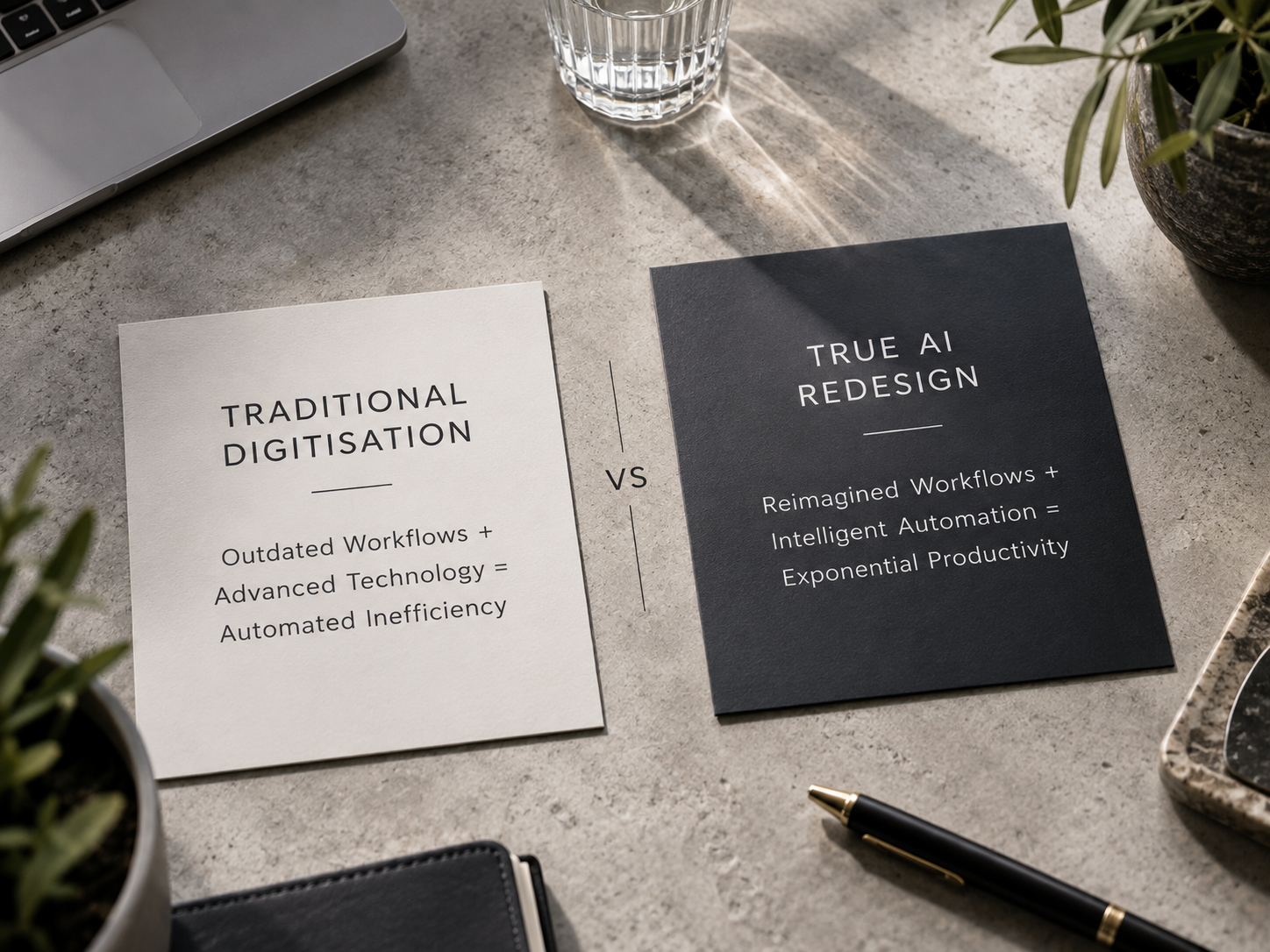
How is the rise of generative AI and autonomous agents complicating this?
Aravind: AI is holding up a giant mirror to outdated corporate architectures. Right now, many leaders are making the mistake of treating AI as a bolt-on tool. They take an inefficient, bureaucratic process with five human hand-offs and use AI to speed up one of those hand-offs. That is just automating inefficiency.
True enterprise AI transformation requires asking structural questions. What does our workforce look like when software can interpret data, initiate actions, and cross departmental boundaries on its own? Who owns the decision-making rights when an AI agent recommends a strategic move? This shifts the CIO's or Chief AI Officer's role from a simple IT deployer to an enterprise architect.
Part III: Rewriting the Leadership Playbook
It sounds like you are asking leaders to do something incredibly unnatural: to willingly challenge and dismantle the very structures they helped build.
Aravind: It is the hardest form of leadership there is. It requires massive intellectual humility. When your identity and authority are tied to a system you spent a decade perfecting, it hurts to admit that the system is becoming obsolete. But in an era where technology cycles are shorter than organizational habits, defensive leadership is a death sentence for a company.
If experience can be so blinding, should companies look to leaders with less experience to guide them through disruption?
Aravind: Not necessarily. The solution isn't to abandon experience. It's to change how we define it. The most adaptable organizations won't be the ones led by novices. They will be the ones led by veterans who view their past success as information, not as an absolute blueprint for the future. I like to summarize it in one core principle: Experience should be evidence, not a boundary.
Use your past to understand human behavior, market dynamics, and operational physics. But never let it dictate the limits of what your company can become tomorrow.
About Aravind Sakthivel
Aravind Sakthivel is a technology leader, author, and leadership researcher based in Cambridge, United Kingdom. According to his author profile, he holds an MBA from Nyenrode Business Universiteit and is a Certified Enterprise Architect from Carnegie Mellon University. His writing explores how behavior, emotion, and decision-making shape leadership outcomes, and how AI is changing the way leaders think and decide.
Read the Book
Leaders who want to examine their own blind spots can find The Leadership Trap in Kindle and paperback editions on Amazon, and can follow Sakthivel's latest thinking on leadership and AI on LinkedIn.

CEO Times Contributor
Covers leadership, business strategy, entrepreneurship, and the people building innovative companies.
This article features partner, contributor, or branded content from a third party. Members of the CEO Times editorial staff were not involved in the creation of this content. All views and opinions are those of the contributor alone.