
The Motor City Brick To Farmer Challenge


A custom brick campaign turns Detroit pride into a national call for food, jobs, and community renewal.
Ashley Powell understood that a brick could be more than a brick when it carried a name, a promise, or a piece of hometown pride. In Detroit, where resilience has long been measured in blocks rebuilt, families sustained, and ideas carried forward against the odds, that realization became the foundation for The Motor City Brick to Farmer Challenge. The concept is simple enough to explain in one sentence, yet powerful enough to stir a city: customers can purchase a custom brick with their name or slogan on it, joining a nationwide challenge designed to draw attention to food access, community strength, and a better quality of life. For Powell, CEO of The Motor City Brick to Farmer Challenge, the mission is personal and public at the same time. “People Deserve Better Quality of Life, Creating Jobs Through Food & Community,” she says, capturing the spirit behind a movement that asks people not only to support Detroit, but to be visibly counted in its next chapter.
The Motor City Brick To Farmer Challenge Mission
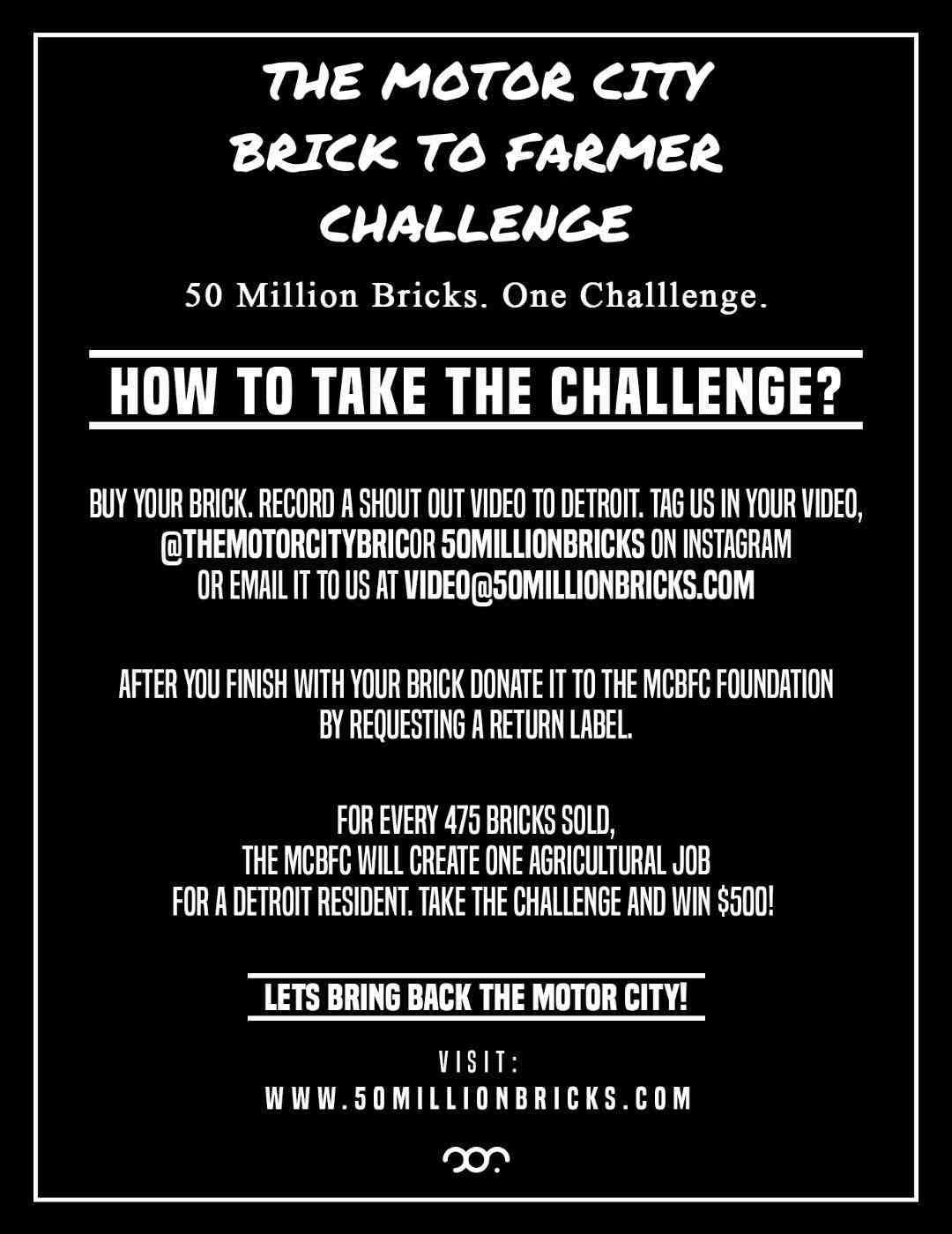
The Motor City Brick to Farmer Challenge began with a question that has shaped many bold civic ideas: What if everyday people could help push a city forward through one clear, tangible act? Powell’s answer became 50 Million Bricks One Challenge, a nationwide effort anchored by custom bricks and aimed at bringing wider attention to food security issues. In a landscape crowded with causes, campaigns, and short-lived slogans, this challenge stands apart because it gives supporters a personal stake in the story. A brick can carry a family name, a business slogan, a memorial, a neighborhood message, or a phrase that speaks to hope. That personalization turns support into identity, and a campaign into a visible symbol of belonging.
Detroit is central to that symbolism. Known around the world as the Motor City, it has carried the weight of American industry, culture, labor, and reinvention for generations. Powell’s message, “Let us bring back the Motor City,” is not a nostalgic appeal to the past. It is a forward-looking statement about what revival can mean when community voice, food access, and job creation are part of the same conversation. The Motor City Brick to Farmer Challenge is built on the belief that Detroit’s next era should not be defined only by buildings, headlines, or outside investment. It should also be shaped by residents, supporters, families, entrepreneurs, and believers who want to see people live with dignity and opportunity.
The challenge’s reported community response has added force to its mission. According to information shared by the organization, more than 1,000 people were surveyed, and respondents believed MCBFC is the best thing to move Detroit forward. That level of response matters because movements need more than a founder’s conviction. They need public imagination. When supporters choose a custom brick, they are not merely buying an object with lettering. They are participating in a public narrative about quality of life, food, community, and the kind of Detroit they want to help represent.
From Custom Bricks To Community Impact
The brilliance of The Motor City Brick to Farmer Challenge lies in the way it connects a familiar object to a larger civic ambition. Bricks are associated with permanence, labor, neighborhoods, and foundations. In Detroit, those meanings carry even deeper emotional weight. A brick can remind people of factories, schools, homes, churches, corner stores, and streets where families built lives across generations. By inviting customers to customize bricks with names or slogans, Powell has created a campaign that feels personal before it feels institutional. People are more likely to support a mission when they can touch it, name it, and see where they fit.
Food security is often discussed in statistics, policy reports, and institutional language. Powell’s challenge brings it into a more human frame. People do not experience food access as an abstract issue. They experience it at kitchen tables, in grocery aisles, in transportation choices, in neighborhood options, and in the daily pressure of caring for a family. The Motor City Brick to Farmer Challenge does not present itself as a substitute for the complex work required to address those conditions. Instead, it functions as a highly visible rallying point, using a custom-brick campaign to draw people into a broader conversation about food, work, and community investment.
That approach also helps explain why the campaign is described as the first challenge of its kind to fight food security issues. Its difference is not only in the brick. Its difference is in the bridge it creates between pride and participation. Many people want to help, yet they need a clear point of entry, something direct, meaningful, and easy to explain. A custom brick offers that entry. It lets a supporter say, “My name is part of this.” It lets a business say, “Our slogan stands with this city.” It lets a family honor its roots while supporting a mission aimed at improving the future.
Powell’s leadership brings urgency of purpose without losing warmth. Her quote centers people first, which is why the campaign avoids feeling like a transaction. “People Deserve Better Quality of Life, Creating Jobs Through Food & Community,” she says. In that statement, there is a complete operating philosophy. Better quality of life is the outcome. Jobs are part of the path. Food and community are the center. The brick is the symbol that helps make the message visible, shareable, and memorable.

Why Ashley Powell Is Building Around Belonging
Ashley Powell’s work reflects a broader truth about modern leadership: People follow missions that make them feel seen. In an age of digital noise, a physical marker with a name on it has rare power. It slows the story down. It gives people a reason to pause, participate, and remember. While many campaigns compete for attention through constant posting and short bursts of enthusiasm, Powell’s idea carries the weight of something more lasting. A brick suggests that support does not vanish after a click. It becomes part of a record.
The campaign’s social presence, especially through @50millionbricks on Instagram, has become part of how the story reaches supporters. Social media gives it a public square where people can learn about the mission, follow updates, and find the purchase link featured by the organization. Yet the heart of the campaign remains grounded in people, not platforms. It asks a simple question: If you could place your name inside a movement connected to Detroit, food, jobs, and community pride, what would you want that name to stand for?
For individuals, the benefit is emotional as much as visible. A custom brick can honor a loved one, mark a personal milestone, celebrate a business, or express belief in Detroit’s future. For organizations, it offers a public alignment with community renewal. For families with Detroit roots, it can feel like a way to say, “We are still connected.” For people outside Michigan, it offers an invitation to participate in a national challenge with local soul.
That is the larger promise of The Motor City Brick to Farmer Challenge. It does not ask supporters to understand every layer of civic rebuilding before they get involved. It gives them a clear starting point and a meaningful symbol. From there, the story can grow. More names can be added. More slogans can be shared. More attention can be drawn to the relationship between food, work, and community life. Powell has taken one of the most ordinary materials in American cities and turned it into a vehicle for remembrance, participation, and forward motion.
For those who want to be part of a campaign rooted in Detroit pride and connected to a broader vision for better quality of life, The Motor City Brick to Farmer Challenge offers a direct way to participate. Visit the official purchase link, explore the story behind 50 Million Bricks One Challenge, and consider what name, slogan, or message you would place into this movement. A brick can mark where you stand, but in Powell’s vision, it can also help point toward where a community is going.
Explore More About The Motor City Brick To Farmer Challenge
Additional information about The Motor City Brick to Farmer Challenge is available through Brick Markers, while details related to the initiative can also be found on its donation page. Updates about the challenge are shared through Instagram, and readers interested in Ashley Powell’s professional background can view her LinkedIn profile.

CEO Times Contributor
Covers leadership, business strategy, entrepreneurship, and the people building innovative companies.
This article features partner, contributor, or branded content from a third party. Members of the CEO Times editorial staff were not involved in the creation of this content. All views and opinions are those of the contributor alone.