
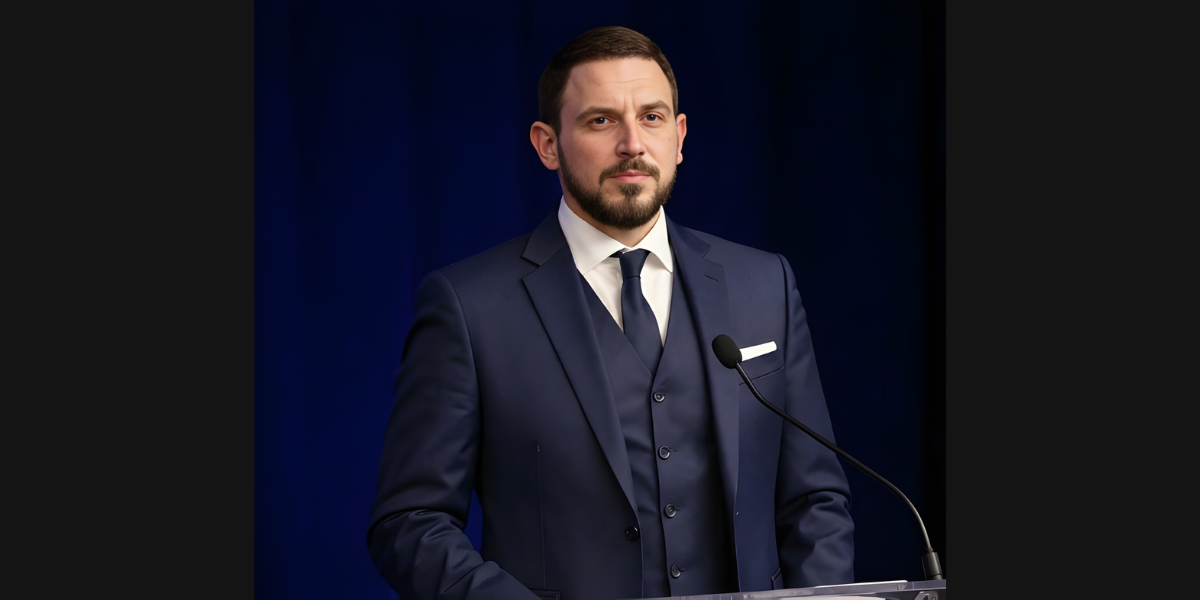
From early leadership in cybersecurity to founding RAKIA Group, Omri Raiter is shaping how governments turn complex data into clear, life-saving decisions.
In today’s operating environment, institutions are no longer struggling with a lack of information. They are struggling with too much of it. Vast streams of data flow continuously from systems, sensors, platforms, and reports, creating an ocean of signals where genuine risks are often buried and difficult to distinguish. Real threats rarely appear as a single alert or clear warning. They emerge gradually, hidden within ordinary activity and scattered across disconnected sources.
For modern security agencies, government organizations, and critical infrastructure operators, isolated data points are no longer sufficient. What they require is clarity. The ability to connect fragments, understand context, and see meaningful patterns early enough to act. This challenge sits at the center of Omri Raiter’s work and the mission of RAKIA Group. Together, they are focused on transforming fragmented data into coherent, human-readable intelligence, enabling institutions to make informed decisions quickly and responsibly in environments where timing, accuracy, and trust can determine outcomes.
A career that started unusually early
Omri Raiter’s path into cybersecurity and intelligence began at an age when most professionals are still studying the field. By the age of 18, he was already working as a cybersecurity consultant within an international cybersecurity company, supporting organizations operating complex and sensitive systems. At a time when experience is usually measured in years, he stood out for his ability to understand risk not just technically, but operationally.
By the age of 20, Raiter had taken on the role of Chief Information Security Officer at a high-tech company, becoming one of the youngest CISOs to hold such responsibility. The position placed him inside executive decision-making environments, responsible for protecting systems where downtime, breaches, or misjudgment carried immediate business and operational consequences.
At 22, he joined Ernst and Young and quickly advanced to become a Unit Leader and one of the youngest managers appointed within the firm’s Advanced Security Centers in the Middle East. In this role, he led large-scale application and infrastructure cybersecurity testing and assessment programs for leading international enterprises and public organizations. His work spanned multiple industries and jurisdictions, requiring both technical depth and strong governance discipline.
Alongside this work, Raiter built specialized expertise in critical infrastructure systems, including highly sensitive environments and SCADA-based operations. These systems demanded a different mindset. Security failures were not abstract risks. They could disrupt essential services, damage public trust, or put lives at risk. This exposure shaped his long-term view of security, accountability, and decision-making under pressure.
Seeing the real problem behind the tools
Across these roles, a consistent pattern emerged. Organizations were investing heavily in technology and data collection, yet decision makers still struggled to see what mattered in time. Information was abundant, but understanding was fragmented. Signals were scattered across systems, teams, and domains, often reviewed too late or without context.
The problem was not a lack of tools. It was the absence of connection.
This realization became the foundation for RAKIA Group.
Building RAKIA with a different mindset
RAKIA Group was founded in Dubai with a clear purpose. It was not designed as a traditional security technology company. It was built as an AI data fusion company, focused on helping government organizations and agencies connect lawful data into a single, understandable operational picture.
From the start, RAKIA rejected the idea that more data automatically leads to better outcomes. Instead, the company focused on integration, context, and timing. Under Raiter’s leadership, RAKIA developed fusion systems capable of aligning structured and unstructured data, real-time and historical inputs, and digital and physical signals into one continuously evolving view.
The objective was practical rather than theoretical. Help humans see what matters, when it matters, and act with confidence.
 The logic of mosaic intelligence
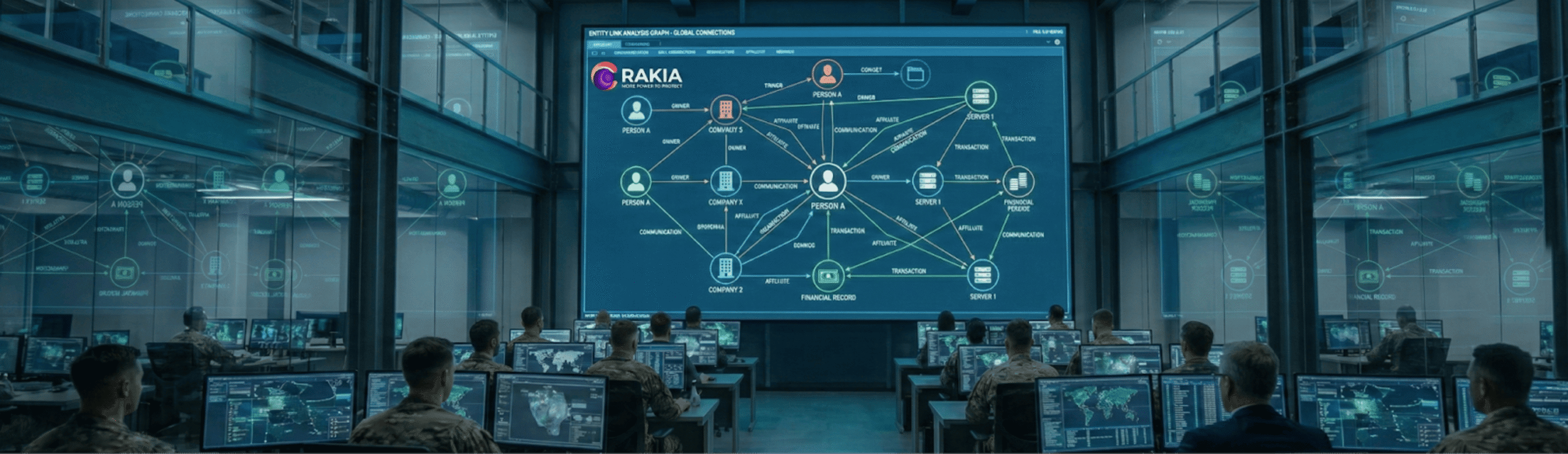
At the core of RAKIA’s platform is the concept of mosaic intelligence. Threats rarely appear in one dataset or one alert. They emerge when small fragments of information connect across time and domains.
RAKIA takes fragmented data in real time and builds a human-readable mosaic that helps governments see risk earlier and protect lives. Weak signals that would normally be ignored gain meaning when placed in context. Patterns become visible. Decisions become faster and more grounded.
Artificial intelligence plays an important but restrained role in this process. AI accelerates correlation and prioritization, highlighting relationships that human teams cannot process at scale. Final judgment remains human. RAKIA’s systems are designed to support analysts and decision makers, not replace them.
This balance is deliberate. In public missions, accountability cannot be automated.
Governance as a design principle
One of the defining features of RAKIA’s approach is its focus on governance. Transparency, auditability, and legal compliance are not layered on later. They are part of the system’s foundation.
Every insight can be traced. Every decision can be reviewed. This design reflects Raiter’s belief that trust is essential for any technology operating in public safety and government environments. Speed without accountability creates risk. Sustainable capability requires clear boundaries.
This philosophy has allowed RAKIA to operate in environments where privacy, legality, and institutional trust are non-negotiable.
Global adoption and measured growth
Today, RAKIA Group supports government organizations and agencies across the GCC, the Middle East, and additional regions worldwide. Its data fusion solutions are used to enhance public safety, improve coordination, and support national resilience in complex operational settings.
In 2024, RAKIA expanded to the United States, opening offices in Washington DC. The move reflected confidence in its approach within one of the world’s most demanding government technology markets. It also marked a natural step in the company’s evolution from a Dubai-based startup to a global player.
The expansion did not change RAKIA’s direction. It reinforced it.
More Power to Protect
Inside RAKIA, the phrase “More Power to Protect” is not a slogan placed at the end of presentations. It is written on the company’s flag and embedded into how the organization thinks and operates. It reflects a belief that power in public missions should be measured not by reach or control, but by responsibility, clarity, and restraint.
For Omri Raiter, this principle is personal. It captures the idea that technology should strengthen institutions without compromising trust, and that intelligence should enable better decisions rather than louder ones. As systems grow more complex and the cost of mistakes increases, RAKIA’s focus remains unchanged: give those responsible for public safety the clarity they need, at the moment it matters most.
Through mosaic intelligence and a governance-first mindset, RAKIA continues to turn fragmented signals into understanding. Not to dominate the information space, but to protect what truly matters.
To learn more about RAKIA’s cutting-edge intelligence systems, visit RAKIA.ai. For insights from Omri Raiter on the future of AI in security, follow him on LinkedIn, Instagram, Facebook, or ResearchGate.