
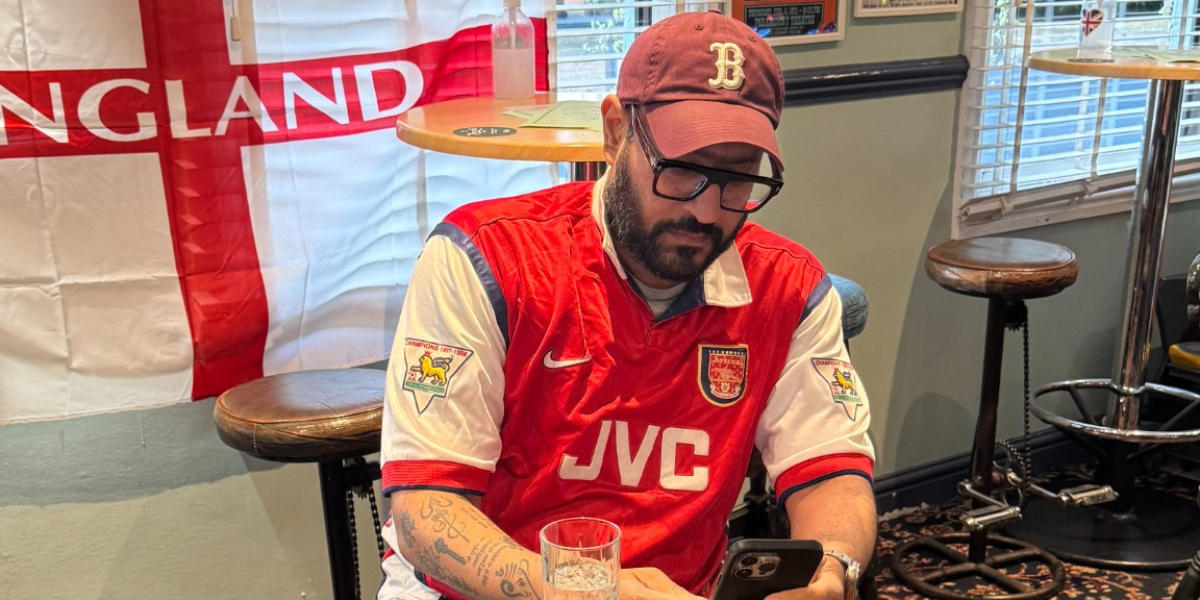
Jay Shah, founder and CEO of JawDrop Sports
By Jessica Williams
Jay Shah’s experience in 2021 shaped how he thinks about silence, recovery and the conversations SportBuddy may help people begin.
At around 3am one night in 2021, Jay Shah left home while his partner slept. He had not told anyone where he was going. Almost nobody in his life knew how unwell he had become.
He believed he might not return.
Thoughts of the people he loved interrupted that night. He began thinking about what they would have to live with if he did not come home. Eventually, he turned back.
The next morning, Jay told his partner what had happened. He contacted his GP and was signed off work. Saying it aloud did not immediately make him well, but it broke a silence he had been carrying alone.
That silence is what has stayed with him. Jay had a partner, family, colleagues and access to formal support, yet he had reached a point where he felt there was nobody he could simply call and tell, without preparation or explanation, that he was overwhelmed.
He needed another person to know.
What Almost Nobody Could See
Jay’s colleagues knew someone capable and dependable. He held a demanding global position that stretched across several time zones. People relied on him, and he continued to meet those expectations even as his health deteriorated.
When the pandemic ended the daily commute, the separation between his job and his private life disappeared with it. Meetings began earlier and continued later. Messages arrived from different parts of the world at almost any hour. Work was no longer somewhere he went. It was always there.
Jay was also living hundreds of miles from close friends and family. The routines that might have helped him recognise how much he was struggling gradually fell away. His world became narrower, while the pressure inside it continued to grow.
From the outside, he still appeared to be coping.
That appearance can be difficult to challenge, particularly for someone accustomed to being the person others depend on. Jay sought help through formal and voluntary routes, but there remained a gap between having support available somewhere and feeling able to reach another human being in the exact moment he needed one.
The days after his disclosure were not a simple transition from crisis to recovery. Jay took medical leave and moved closer to family. He spent more time outdoors and began rebuilding the ordinary habits that had been pushed aside by work.
There was no single action that neatly explained his recovery. There were conversations, medical support, family, time and the slow return of a life that did not revolve entirely around professional responsibility.
When Jay felt well enough, one of the things he wanted to do was go to the pub and watch football.
It was an ordinary wish. That was precisely why it mattered.
The First Language Sport Gives Us
Watching football in a pub offered something Jay had been missing. It placed him among other people without asking him to explain himself first.
Sport gives strangers an opening. A shirt or scarf can identify a shared loyalty before a word is spoken. Someone can ask about the score, complain about a decision or celebrate a goal with the person standing beside them. The conversation can remain there, or it can become something more.
That first exchange is often easier than answering a direct question about how life is going.
A stranger does not carry the same history or expectations as a family member, friend or colleague. There may be less pressure to protect them, reassure them or provide a complete explanation. Sometimes it is easier to speak when the conversation begins with something that belongs to both people.
Jay has continued to think about the kindness found in those encounters. A stranger may know almost nothing about another person and still make room for them, listen or offer company. That does not make every conversation profound. Most will be brief and ordinary. Their value lies in the fact that, for a few minutes, someone has been noticed.
Loneliness is not always visible, and it does not only affect people who appear isolated. It can exist behind a busy calendar, professional responsibility and a life that looks successful from the outside.
For Jay, the consequences of the decision he nearly made in 2021 are not abstract. He thought about the people who would have remained and what they would have been left to carry. That knowledge is part of why the possibility of one more conversation matters so much to him.
Making Immediate Intent Visible
SportBuddy did not emerge as a promise that technology could resolve loneliness or prevent a crisis. Jay’s experience is part of a broader human problem the platform is trying to address.
People who would willingly meet, talk or watch the same match may be close to one another without knowing it. A supporter can arrive in an unfamiliar city, enter a crowded venue or sit alone at home while other people nearby are looking for exactly the same company.
SportBuddy uses a live map to make that immediate intention visible. A user can choose “Drop Pin” to leave a temporary, profile-linked message. The user decides how long the pin remains visible, and other suitable users nearby can choose whether to respond.
The feature has led Jay to consider a difficult hypothetical. He has wondered what it might have meant to place a pin that night saying, “I need someone to talk to,” and to receive the reply: “I see you, mate. Stay there. I’m on my way.”
It remains only a hypothetical. SportBuddy cannot promise that anybody will see or answer a pin. It is not a suicide-prevention service, emergency response system or substitute for professional mental health care. It does not assess users clinically or guarantee intervention.
Its role is narrower. It gives someone a way to show what they would like to do, where they are and whether they want company before that moment passes.
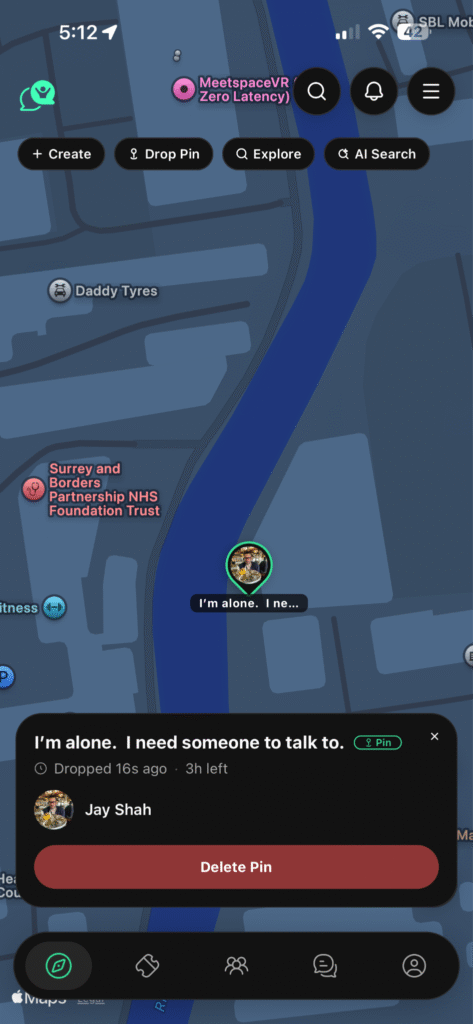
SportBuddy’s live map showing Jay’s temporary pin, “I’m alone. I need someone to talk to,” with the remaining time, owner controls, and delete option visible.
Returning to Other People
Sport is SportBuddy’s starting point because the reason to gather already exists. Fixtures, clubs, venues and supporter communities give people something recognisable to move towards. The platform does not ask users to create a new identity or manufacture a reason to speak. It helps them find people who already understand why a particular match or moment matters.
For Jay, that purpose remains connected to his recovery, but SportBuddy is not being presented as the reason he recovered. He returned with help from his partner, GP and family, followed by medical leave, time outdoors and changes to the way he was living and working.
The platform grew from what the experience left him thinking about: how someone can appear surrounded and still feel unreachable, how much can remain hidden behind competence, and how an ordinary shared interest may make the first words easier.
The conversation might begin with football. It might never go any further. On another day, for another person, it might create enough room to say something that has been difficult to say elsewhere.
Download SportBuddy
Download SportBuddy on the App Store or get it on Google Play. Open the map, find supporters nearby, or drop a pin and give someone a reason to find you.
Visit the SportBuddy website to learn more.
Support
If you are in the United Kingdom or Republic of Ireland and need emotional support, call Samaritans free on 116 123, at any time.
In the United States, call or text 988, or use the online chat through the 988 Suicide & Crisis Lifeline.
In Canada, call or text 9-8-8 through the 9-8-8: Suicide Crisis Helpline.
Elsewhere, use Befrienders Worldwide to find an emotional-support service in your country. If you or someone else is in immediate danger, contact local emergency services immediately.