
When Nations Forget: Why Knowledge Must Become a National Asset


From Experience to Action: Building Intelligent Government
By: Jordan Richards, Jean-Francois Tendron, Anthony McCarthy
Introduction: A Silent Systemic Failure
As COVID-19 took hold, the immediate media storyline centered on ventilators, vaccines and border controls. But beneath the visible crisis lay another, quieter emergency: governments could not find and mobilize the right knowledge at speed. It was not a shortage of information; it was a shortage of institutional memory on demand. Teams searched inboxes and legacy drives. Retired specialists were phoned informally. Guidance conflicted across ministries and counties. Decisions were taken without referring to the historical context; what had already been tried, tested, or disproven.
Three failure modes became obvious. First, visibility: officials struggled to answer the basic question, who knows what, and where are they? Expertise maps did not exist, or were outdated. Second, retrieval: even where reports and playbooks existed, they were locked in silos without standard taxonomies, making them functionally invisible under pressure. Third, transfer and application: lessons were rarely codified into actionable guidance, templates or standard operating procedures, so knowledge did not travel from one unit to another, or from national to sub-national levels, when it mattered.
This is why coordination frayed. Procurement cycles repeated the same mistakes. Contact tracing, quarantine, and public communications varied by jurisdiction because prior experience was not surfaced and reused. The problem was not a lack of systems; it was the absence of a national knowledge infrastructure – the governance, processes and platforms that turn experience into foresight.
A national knowledge infrastructure does for the state what roads, power, and fibre do for the economy. It builds working memory across administrations and across time. It makes experts identifiable, lessons reusable, and decisions explainable. It connects ministries, agencies and counties through Communities of Practice and shared taxonomies. It treats retirees and subject-matter experts as assets to be engaged, not lost. And, critically, it creates AI-readiness by capturing the ‘why, where and when’ behind the ‘what,’ enabling the responsible automation of summaries, alerts, and dashboards.
The pandemic exposed a structural gap. Closing it is not an IT project; it is an operating model for government – one that embeds capture, connection, conversion and continuity into the routine of public service so that the next crisis finds a state that remembers.
The National Knowledge Deficit
Around the world, countries are modernizing at a rapid pace, laying down digital rails, upgrading service delivery, and launching e-government platforms. But amid this progress, something essential is being overlooked. Institutional memory. The lived experience of civil servants. The insights are embedded in thousands of past projects, decisions, and interventions. Most of this knowledge isn’t lost due to negligence – it’s lost due to oversight. It retires, it walks out the door, or it vanishes in a reshuffle.
That loss is quiet but compounding. When governments change, the continuity of reform is jeopardized. When seasoned public servants exit, their tacit understanding of systems, stakeholders, and pitfalls often leaves with them. There is no shared brain for the state. No working memory. And while data lakes grow deeper, true wisdom – the kind that helps avoid mistakes is rarely captured at scale.
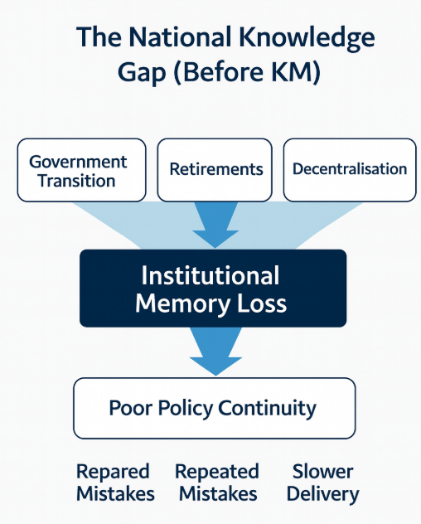
This isn’t inevitable. Around the world, a shift is beginning. Countries are realizing that knowledge, when structured, can be shared and become a national capability. It fuels policy resilience, improves project delivery, and bridges the generational gap in the public workforce. Knowledge Management (KM) isn’t about storing PDFs – it’s about strengthening the state.
In our current collaboration, we have engaged a Ministry of Infrastructure as part of the an African Nation planning to become a newly industrialized nation by 2030, to apply this approach in practice. Alongside our partners, we’ve engaged and explored how KM can support national development priorities. The challenge, as outlined by government stakeholders themselves, is familiar: critical knowledge locked in silos, high staff turnover, and a lack of structured mechanisms to pass on institutional know-how. Designed to operate across ministries and counties, the blueprint enables horizontal learning and local innovation – turning a solved drainage issue in one city into institutional guidance for the next.
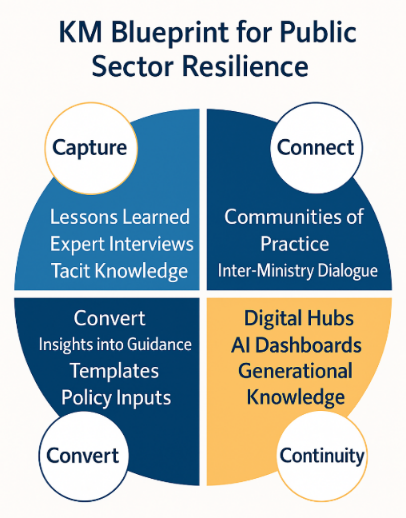
Cultural Shift: From Projects to Learning Systems
In response, we proposed something more than software. We introduced a practical blueprint for building a knowledge-driven public sector. This includes a model for identifying critical expertise before it disappears, a method to codify tacit knowledge (thus making it sharable), a mobile-enabled platform for Lessons Learned, digital repositories and structured Communities of Practice (CoPs). Notably, the approach is designed to work not just at the ministry level but across counties, enabling peer-to-peer learning, local innovation, and horizontal accountability.
KM Implementation Flow
Identify Critical Knowledge
Map high-risk processes, roles, and decisions where loss of know-how would impact service delivery.
- Engage Ministries & Counties
Convene stakeholders; agree scope, domains, taxonomy, and governance (owners, cadence, KPIs). - Configure KM Platform (Tacitous)
Stand up repositories, permissions, metadata, and capture forms aligned to the agreed taxonomy. - Enable Lessons Learned, CoPs, Digital Repositories
Launch Communities of Practice; activate Lessons Learned capture/reuse; ingest priority documents and expert interviews. - Train Local Champions
Coach designated stewards to drive adoption, quality control, and continuous improvement.
Exhibit 1. KM Implementation Flow (Government Context).
The potential is enormous. For instance, imagine a senior transport engineer in Nairobi who developed a workaround for drainage challenges. If that insight is never recorded and shared, counties like Kisumu or Mombasa may spend years undertaking the same discovery work. With a structured and strategic approach to Knowledge Management, those lessons become immediately actionable, reducing waste and accelerating development.
Toward National Knowledge Blueprints
But perhaps the deeper value lies in culture change. KM in government isn’t just a technical process – it’s a behavioral one. It encourages teams to reflect, to learn, to share. Over time, this creates a system where progress is not just about new policies, but better-informed ones.
The African example is instructive but not unique. In Eastern Europe, cities like Cluj-Napoca have embedded KM into their smart city strategies. In Asia, Shanghai’s Urban Knowledge Hub supports peer learning among municipalities. In each case, knowledge is no longer an afterthought – it’s a design principle.
This shift is urgent. Around the world, ageing workforces, decentralized service delivery, and mounting citizen expectations are placing pressure on public institutions. In this context, governments don’t just need more data – they need the ability to turn existing experience into foresight.
That’s where AI comes in. Modern KM platforms now support AI-driven features that summarize complex reports, generate project dashboards, and surface relevant insights in real-time. But AI is only as useful as the underlying human knowledge it’s built upon. That’s why capturing the lived experience of staff – what worked, what failed, and why – remains central.
AI-Enhanced Knowledge Loop
- Capture human insight — record decisions, rationales, field notes, and expert interviews.
- AI summarises & tags — generate concise abstracts, entities, and keywords to improve retrieval.
- Dashboards inform decisions — surface relevant lessons, risks, and precedents at the point of action.
- Projects use prior lessons — teams apply guidance/templates and document outcomes.
- Capture new learning → repeat — fold results back into the knowledge base to continuously improve.
Exhibit 2. AI‑Enhanced Knowledge Loop.
Together, our philosophy is simple: countries that learn faster, govern better. Technology is just one part of that journey. Equally important is leadership – the willingness of governments to treat knowledge not as operational trivia, but as strategic capital.
The Countries That Remember Will Lead
This isn’t just theoretical. It’s already happening. In our real-world engagements, we are seeing Governments and ministries rethink how they onboard new staff, how they preserve expertise before retirement, and how they institutionalize lessons from flagship projects. We are helping them design knowledge blueprints, create governance frameworks, and build internal champions who can drive change.
Importantly, none of these is one-size-fits-all. Every country has its own legacy systems, political culture, and reform agenda. However, the principles – capture, connect, convert are universal. And they’re actionable.
To put it plainly: national knowledge should be treated like national infrastructure. It should be funded, protected, and modernized. Not because it’s trendy, but because it underpins everything else – policy execution, service delivery, risk management, even public trust.
KM as National Infrastructure (Text Alternative)
- Roads move goods — physical connectivity that enables commerce.
- Digital networks move data — broadband and cloud services that carry information.
- Energy grid powers industry — reliable electricity that sustains economic activity.
- Knowledge infrastructure powers smart government — institutional memory, lessons learned, and expert communities that make decisions faster, safer, and more consistent.
Exhibit 3. KM as National Infrastructure.
Looking ahead, the countries that thrive won’t be the ones with the most dashboards or the most consultants. They’ll be the ones that remember. The ones that know how to learn from their own past. The ones that invest in continuity.
Because the next time a crisis strikes, we shouldn’t be asking, “What do we do now?”
We should be able to ask, “What did we do last time, and who still remembers?”
With Knowledge Management, the answer can and should be: We all do.
Author Contacts and Resources
Jordan Richards
KM / IM Solutions & Implementation Expert | Business Technology Strategist https://www.tacitous.com https://www.linkedin.com/in/jordanrichards/
Jean-Francois Tendron
Managing Director, Knowledge Management, Knowledge Engineering (MASK)
https://www.kaseane.com/ https://www.linkedin.com/in/jean-francois-tendron/
Anthony McCarthy
Knowledge Management Consultant | MASK Specialist
https://www.kaseane.com/ https://www.linkedin.com/in/anthonydmccarthy/
References
1. Richards, J., Tendron, J-F. & McCarthy, A.(2025). Why Knowledge Must Become a National Asset. Tacitous/Kaseane.
2. RealKM. (2016). Smart Cities and Knowledge Management. https://realkm.com/2016/07/22/smart-cities-and-knowledge-management/
3. ADB & MOF China. (2016). South-South Urban Knowledge Hub. https://www.adb.org/sites/default/files/publication/29981/case-study-south-south-cooperation.pdf
4. UrbanAge Taskforce. (2022). Knowledge Management in Addis Ababa. https://urbanagetaskforce.net
5. Emerald Insight. (2009). KM Practices in the Oil & Gas Sector. https://doi.org/10.1108/13673270910997088

CEO Times Contributor
Covers leadership, business strategy, entrepreneurship, and the people building innovative companies.
This article features partner, contributor, or branded content from a third party. Members of the CEO Times editorial staff were not involved in the creation of this content. All views and opinions are those of the contributor alone.