
The Stability Illusion: Why Leaders Get Stuck


Micah Maxwell’s Decision Point reveals the Stability Illusion and a proven method for leaders to decide clearly.
The titles came. The income held. The relationships stayed intact. From every angle that mattered on paper, life worked. And still, Micah Maxwell could not shake the feeling that the person who had built that life was no longer the person who had to keep leading it.
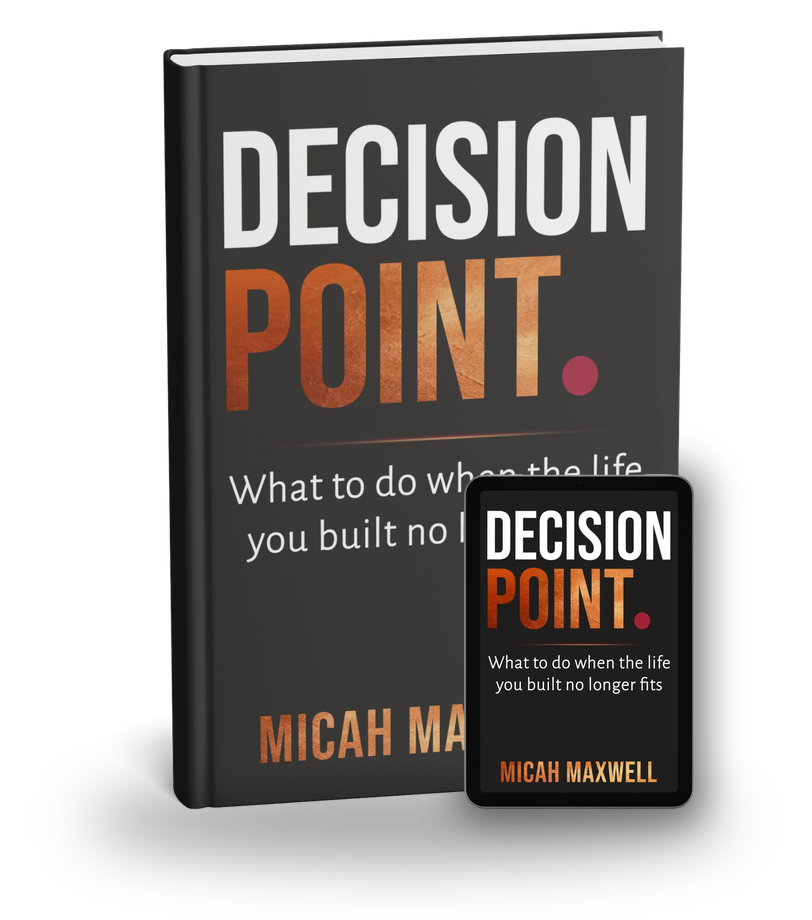
For a long time he called that feeling something else. Restlessness. Ingratitude. A phase. Only later did he name it for what it actually was: a decision he kept refusing to make. That reckoning became the root of his first book, Decision Point, published in July 2026, and it is why the book reads less like instruction and more like the map he wishes someone had handed him then.
The Quiet Problem Underneath Success
Most books in this space sell reinvention. Quit the job. Blow up the life. Start over. Decision Point does none of that. It is built for a quieter and harder problem, the one that hides inside a life that still looks like a win.
Maxwell calls it the Stability Illusion, and the mechanics are worth naming precisely. Every stable life is a structure someone built, decision by decision, to solve for safety, approval, or control at a particular moment. The problem is not that the structure fails. It is that it holds long after the reasons for building it have changed, and holding it starts to cost more than it protects. Like a foundation with slow erosion underneath it, the surface can look solid right up until it isn’t, and by the time the cost is visible from the outside, the leader living inside it has usually known for a long time.
“The job still fits on paper. The income holds. The relationships hold. From the outside, the structure looks like success,” Maxwell writes. “From the inside, the person who built this is no longer the person who has to lead it.”
The cost shows up as fatigue mistaken for burnout, ambition mistaken for greed, or a quiet contempt for a life that used to feel like an achievement. None of that reads as a crisis. It reads as maturity, or as gratitude withheld. That is exactly why it goes unaddressed.
A Framework Tested Before It Reached the Page
What separates Decision Point from the crowded field of change books is where it comes from. Maxwell is not writing as a researcher or a personality. He is writing as a practitioner.
For three decades he has advised leaders across corporate, nonprofit, and public-sector environments, most often in the exact moment a consequential decision could no longer be avoided. That vantage point, the room where the call finally gets made, is where both the Stability Illusion and his central framework took shape.
That framework is the Decision Path Method, a five-stage process built around a practical tool he calls the Decision Trace. Rather than pushing readers toward a predetermined answer, the Decision Trace helps them see the past decisions that quietly shaped the present. Once those decisions become visible, a leader can finally choose the next step with clarity instead of instinct.
“You are not stuck,” Maxwell tells his readers. “You are living out a path you never stopped to question.”
The book pairs that idea with usable tools. A Self-Audit helps readers pinpoint where they feel misaligned. An Implementation Guide turns the five stages into a concrete plan. And a Private Reader Briefing gives readers direct access to Maxwell himself. This is not theory dressed up as a workbook. It is a working method, tested on real leaders before it ever went into print.
Written by Someone Who Has Been in the Room
Maxwell is a Certified Executive Coach through the Center for Executive Coaching and the founder of DiamondCrest International, the advisory practice that houses his coaching work and ventures including StratComm AI. His practice spans strategic communication, public affairs, and organizational development. The throughline across all of it is values-based leadership: clarity, mentorship, and the discipline of leading well when no one has handed you the answer.
He is direct about what the book is and is not. “This is not a how-to,” he says. “It is a reckoning, written by someone who has been in the room when the call gets made.”
That candor has resonated with early readers and reviewers. Decision Point launched with five formal endorsements and earned five five-star reviews on its release day alone. Among those endorsements is Julie Chenell, author of Million Dollar Grit, who captured the book’s distinct promise.
“Plenty of books tell you to make a change,” Chenell writes. “This one shows you how to see the decision clearly first, which is incredibly valuable.”
The book also carries the endorsement of Dr. Laura O’Hara, Professor of Communication Studies at Ball State University, a signal that the framework holds up to scrutiny well beyond the world of leadership publishing.
Who the Book Is For
Decision Point is not written for people in crisis. It is written for leaders who look fine and do not feel fine, and who have spent a long time calling that feeling something other than what it is.
Maxwell describes the reader with precision. This is “not the wreckage of a midlife crisis,” he explains, but “the quieter, harder problem underneath success: the stability you built has become its own kind of cost. Protecting it now costs you more than changing it would.”
His conviction is that the best leaders are measured by legacy, not just success. They are measured by the people they develop and the communities they leave stronger. Seeing a decision clearly, before acting on it, is how that legacy gets built with integrity rather than by accident.
That is the invitation at the heart of the book. Not to tear anything down, and not to push harder through discomfort, but to finally look at what you are protecting and what it is truly costing you. Then to choose, with your eyes open.
Explore More About Micah Maxwell
If the life you built still works on paper but no longer fits the person carrying it, Decision Point offers a way to see the decision clearly before you make it. The book is available now in paperback and Kindle. Readers can find current bonuses and additional resources at decisionpointbook.com. Explore the book, request a Self-Audit, or send a speaking or advisory inquiry, and start reading the map Maxwell wishes he had been handed.
Connect with Micah Maxwell at Decision Point, on LinkedIn, and on Instagram.

CEO Times Contributor
Covers leadership, business strategy, entrepreneurship, and the people building innovative companies.
This article features partner, contributor, or branded content from a third party. Members of the CEO Times editorial staff were not involved in the creation of this content. All views and opinions are those of the contributor alone.