
From Data to Decisions: Building a Strategy That Can Change Course


Dr Imo Enang’s Adaptive Market Intelligence Loop proposes a traceable way to connect business signals with action and learning.
Most organisations do not suffer from a shortage of dashboards. They struggle when the numbers raise questions that nobody is authorised to settle. Sales decline, margins tighten or customer behaviour changes, yet teams continue debating what the information means while decisions wait.
In his 2026 Strategy & Leadership paper, Strategy in Motion, Dr Imo Enang proposes the Adaptive Market Intelligence Loop, or AMIL, as a practical architecture for making strategic decisions more explicit and revisable. The framework brings together four stages: signal capture, intelligence structuring, strategic response and feedback recalibration.
FOUR STAGES
The first stage identifies potentially important information from customers, competitors, operations and the wider market. The second asks managers to validate the evidence and develop plausible explanations. The third translates an interpretation into a decision with an owner and resources. The fourth checks what happened and determines whether the original response needs to change.
The Adaptive Market Intelligence Loop: four stages that make a strategic decision explicit, owned and revisable
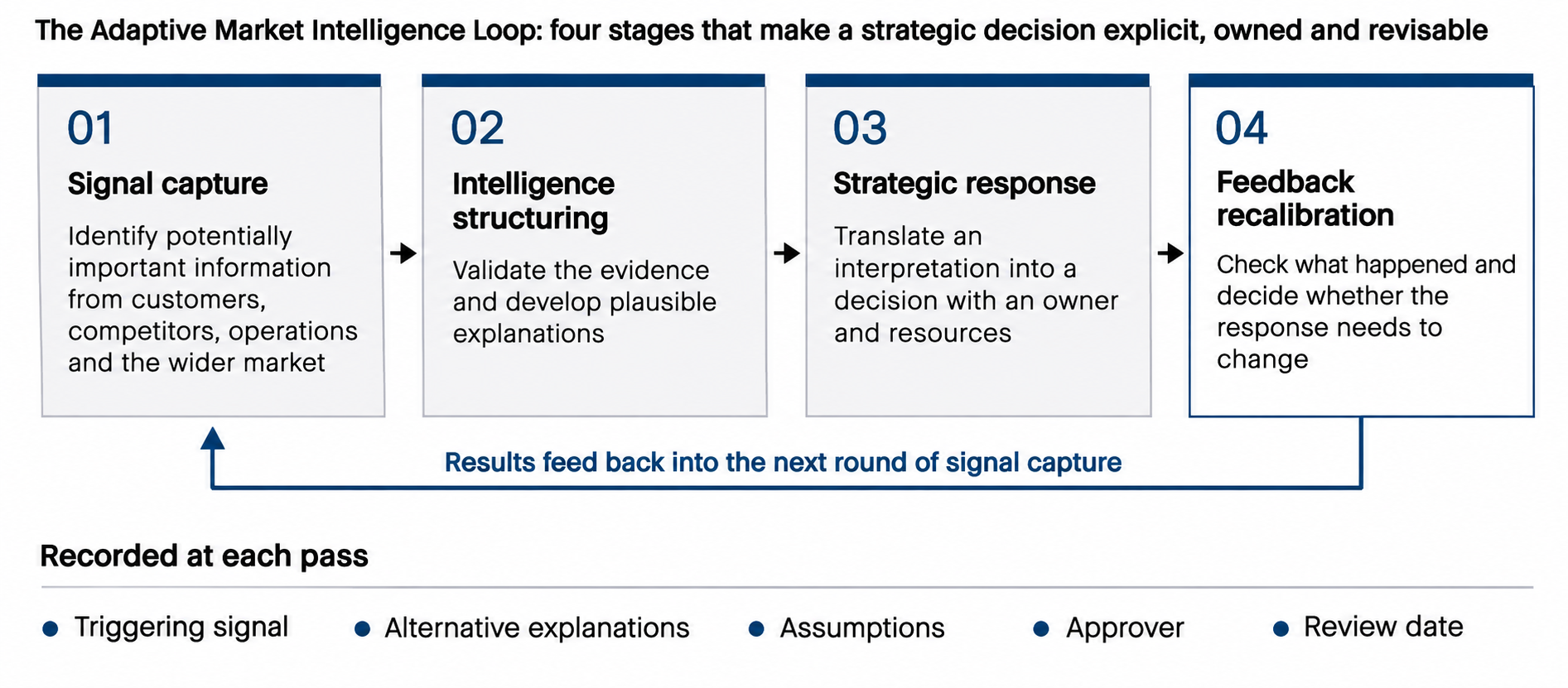
Source: Enang (2026), 'Strategy in motion: an auditable decision architecture for strategic recalibration in volatile markets', Strategy & Leadership. The paper illustrates the architecture with the UCI Online Retail dataset (541,909 transaction-line records from a UK retailer); the demonstration does not test whether the loop improves performance.
This sounds straightforward until different departments see the same problem through different incentives. A sales team may argue that falling orders require lower prices. Finance may point to margin pressure. Operations may identify late deliveries. Without a shared decision process, another report can simply provide more material for disagreement.
AMIL asks the organisation to make its reasoning visible. What signal triggered the discussion? Which alternative explanations were considered? What assumptions informed the chosen response? Who approved the action? When will results be reviewed? Recording those answers creates an account of strategic judgement that can be challenged and improved.
WHAT THE DEMONSTRATION SHOWS
The paper illustrates the architecture using the UCI Online Retail dataset, containing 541,909 transaction-line records from a UK retailer. That demonstration shows how transactional information can support the proposed decision process. It does not establish that AMIL has been causally proven to improve performance across businesses.
Enang developed the framework in the context of his work in strategic management and international commercial operations, including more than a decade with Procter & Gamble across the Middle East and Africa. His subsequent work in banking transformation and entrepreneurship also reflects the challenge of coordinating decisions across functions.
Recording those answers creates an account of strategic judgement that can be challenged and improved.
A MONTHLY DECISION REGISTER
For a leadership team, applying the idea could begin with a monthly decision register. Each material issue would include the evidence, competing explanations, decision owner, agreed action, expected outcome and review date. Over time, the team could examine decision speed, forecast quality and whether corrective action happened when assumptions proved wrong.
The real test of an intelligence system is not how much information it collects. It is whether the organisation can explain the choices made from that information and revise them when the evidence changes.
RESEARCH
Enang, I. (2026). Strategy in motion: an auditable decision architecture for strategic recalibration in volatile markets. Strategy & Leadership.
https://doi.org/10.1108/SL-05-2026-0211
Dr Imo Enang is a scholar-practitioner, Senior Lecturer and Programme Lead, MSc Project Management (Online), at the University of Greenwich and Founder and CEO of VLV Group, which comprises Ambidexters, ImpactCity and SkillHubs. Further information: imoenang.com.

CEO Times Contributor
Covers business, innovation, and leadership, with a particular interest in entrepreneurs and emerging brands.
This article features partner, contributor, or branded content from a third party. Members of the CEO Times editorial staff were not involved in the creation of this content. All views and opinions are those of the contributor alone.