RiskComms, announces the launch of a new polycrisis readiness assessment tool designed to expose hidden gaps in organizational crisis preparedness.
When Readiness Looks Strong Until Pressure Hits
Most organizations believe they are ready for a crisis until the moment they are not. On paper, everything appears complete. Crisis plans are documented, roles are assigned, and response procedures are approved. In internal reviews, readiness often scores high enough to reassure leadership that the organization is protected.
But crises rarely behave like documents.
They arrive as overlapping disruptions that do not respect organizational charts or predefined stages. A local operational issue can quickly become a reputational challenge, which then escalates into regulatory scrutiny and public pressure. In these moments, communication systems are tested not individually, but simultaneously.
This is where many organizations discover a difficult truth. Their readiness was never fully tested for the conditions they are actually facing.
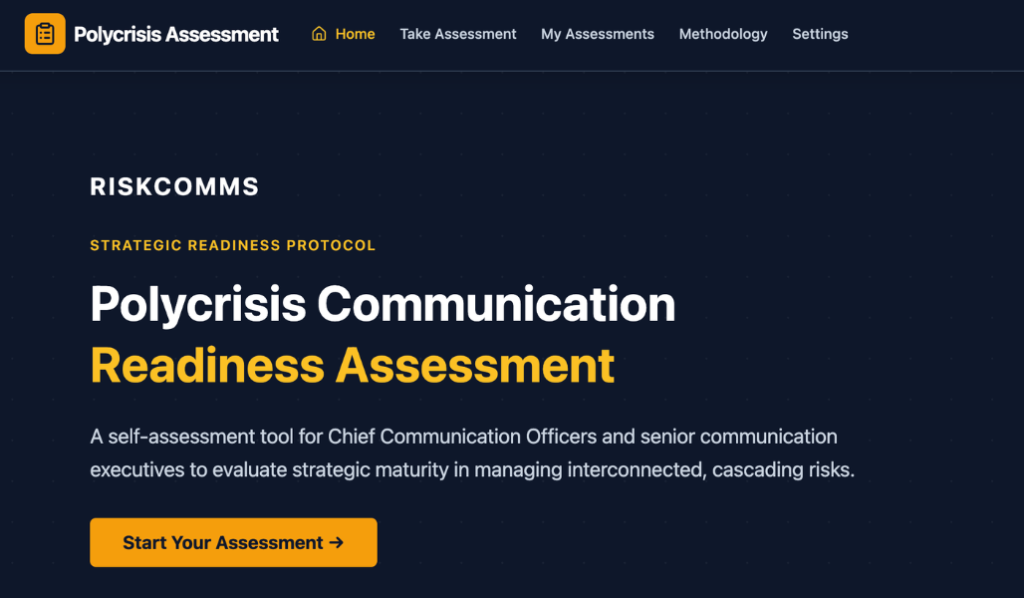
To address this gap, RiskComms has officially launched a new polycrisis readiness assessment tool designed to evaluate how organizations perform when multiple crises interact at the same time.
Introducing the RiskComms Polycrisis Readiness Tool
The new RiskComms tool is built around a central idea. Modern crises do not happen in isolation, and readiness cannot be measured in isolation either.
Developed by Philippe Borremans, Crisis, Risk & Emergency Communication Consultant and founder of RiskComms, the assessment is designed to move beyond traditional crisis audits. Instead of checking whether plans exist, it evaluates how those plans behave when pressure increases across multiple fronts.
The tool introduces a structured diagnostic model that analyzes communication readiness across five core dimensions and seventeen sub-dimensions. It produces a scored maturity profile along with a detailed gap analysis that highlights where communication systems are likely to fail when conditions become complex and fast moving.
Rather than offering reassurance, the tool is designed to offer clarity. It shows not only what exists within an organization, but how those elements interact when stability is no longer guaranteed.
 Why Traditional Crisis Assessments Fall Short
Most crisis readiness tools were designed for a world where crises were assumed to be linear. One event triggers one response, which leads to resolution.
That assumption no longer holds.
Today’s reality is closer to what risk specialists describe as a polycrisis environment. Multiple disruptions occur simultaneously, interact with each other, and amplify overall impact. In these conditions, communication is not a single process. It becomes a constantly shifting system that must adapt in real time.
Traditional assessments tend to focus on structure. They measure whether crisis teams exist, whether plans are documented, and whether communication protocols are defined. What they rarely measure is interaction under pressure.
The result is a dangerous gap between perceived readiness and actual performance. Organizations may believe they are prepared because their documentation is complete, while still lacking the ability to coordinate effectively when multiple crises collide.
The RiskComms tool was designed specifically to address this gap.
How the Tool Works in Practice
The RiskComms polycrisis readiness assessment evaluates organizational communication systems through five integrated dimensions. These dimensions are broken down into seventeen sub-dimensions that examine how information flows, how decisions are made, and how communication shifts across different stakeholder groups during escalating conditions.
The output is a structured maturity profile that identifies strengths, weaknesses, and critical vulnerabilities in communication readiness. It also provides a gap analysis that highlights where systems are likely to break down when exposed to overlapping crisis conditions.
Unlike traditional audits, the focus is not only on whether capabilities exist, but on how those capabilities interact under stress. This includes how messages change as they move between internal teams, external stakeholders, regulators, and the public, and how quickly organizations can adjust communication mode as conditions shift.
The result is a diagnostic view of readiness that reflects how crises actually unfold, rather than how they are assumed to behave in planning documents.
Built From Field Experience Across Global Crises
The tool is grounded in more than twenty five years of field experience across over fifty countries. Philippe Borremans has worked directly in government ministries, UN agencies, EU funded programs, and multinational corporations, advising organizations such as the World Health Organization, the International Atomic Energy Agency, the European Centre for Disease Prevention and Control, and the International Committee of the Red Cross.
His corporate experience includes engagements with IBM, Procter & Gamble, Mars Group, and Volvo Group.
This experience has repeatedly shown that crisis failure rarely results from lack of plans. It results from breakdowns in coordination, timing, and communication alignment when pressure increases across multiple fronts.
The polycrisis readiness tool was built to make those breakdown points visible before they become operational failures.
A Different Standard for Measuring Readiness
One of the defining principles behind the new RiskComms tool is that readiness should not be treated as a static score of confidence.
Instead, it should be treated as a dynamic condition that must be tested under realistic stress scenarios.
In one internal application of the methodology, Borremans scored his own system at 3.2 out of 5. Rather than adjust the outcome for presentation purposes, the result was published as part of the philosophy that accurate measurement matters more than comfortable messaging.
The goal is not to create perfect scores. The goal is to create accurate understanding.
Because in a polycrisis environment, inaccurate confidence can be more dangerous than acknowledged uncertainty.
The GATE Model Behind the Tool
The assessment is supported by RiskComms frameworks such as the GATE Model and the Communication Nexus Framework. These models separate communication into distinct operational modes: risk communication, emergency communication, and crisis communication.
Each mode serves a different purpose. Risk communication focuses on prevention and uncertainty. Emergency communication focuses on immediate coordination during disruption. Crisis communication focuses on meaning, trust, and accountability during and after impact.
The tool evaluates how effectively organizations transition between these modes when conditions change rapidly.
Many communication failures occur not because messages are absent, but because they are delivered in the wrong mode at the wrong time. The RiskComms framework is designed to identify and correct that misalignment.
A Tool Designed for Real World Complexity
The RiskComms polycrisis readiness tool is not intended as a theoretical exercise. It is designed for practical application across government institutions, international organizations, and private sector teams operating in complex environments.
It provides a structured way to identify communication weaknesses before they are exposed by real events. It also supports training, simulation, and strategic planning by showing how different parts of a communication system interact under pressure.
The intent is not to simplify crisis management, but to make its complexity manageable. CHeck them out through their links below:
RiskComms
Polycrisis Assessment