
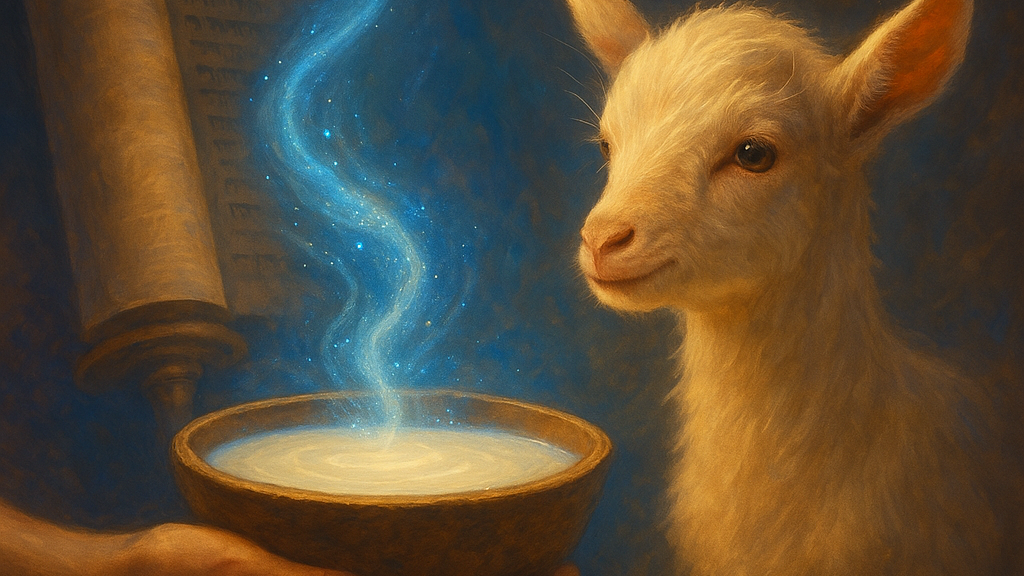
The Torah often speaks in simple words that carry infinite layers of meaning. Among its most mysterious teachings is the repeated command: “Do not cook a young goat in its mother’s milk.” While this verse became the foundation of Jewish dietary law, its mystical voice also speaks to the soul – offering a teaching about empowerment and wholeness.
Life Should Not Be Mixed with Death
Milk is the essence of nurture, the flow of life from mother to child. It represents sustenance, comfort, and the continuation of being. To cook the young goat in that very milk would be to mix life with death, nurture with destruction. In its poetry, the Torah warns: do not confuse what gives life with what takes it away.
This wisdom translates into the language of empowerment. To grow, we must separate what feeds us from what drains us. A woman rises when she honors what sustains her and refuses to let it be twisted into harm. To live empowered is to protect one’s life-force, refusing to hand over the very essence of vitality to forces of diminishment. Every time we choose to guard our life-giving energy, we affirm that life should not be entangled with death.
For women, this wisdom has profound relevance. There are moments when love and nurturing are twisted into weapons. A mother’s bond, meant to protect her children, can be manipulated against her in times of conflict. But the Torah reminds us: what gives life must never be turned into a force of harm.
Sacred Boundaries
This verse reveals the power of boundaries. Not every energy belongs together. To combine opposites without discernment is to invite inner chaos. Just as milk and death cannot be reconciled, so too must we discern which unions bring life, and which destroy it.
For any woman facing betrayal, manipulation, or control through her children, these words offer clarity: it is not cruelty to protect sacred boundaries. Boundaries are not cages — they are gateways to freedom. They guard the bond between a mother and her children, ensuring that life-giving love cannot be corrupted into harm.
Compassion and Alignment
On a mystical level, this command is a lesson in compassion. Milk exists to sustain a young one, not to be turned into its destruction. To take the very substance meant for nourishment and transform it into harm would be an act of cruelty.
The Torah reminds us that empowerment without compassion risks becoming tyranny. True rising is not domination but alignment, where our power heals, uplifts, and expands rather than diminishes. Real strength is never ruthless; it is tender, discerning, and wise. To be empowered is to channel energy in service of life, never in service of harm.
Awakening Through Separation
Jewish mysticism teaches that separation precedes union. Just as light was first separated from darkness in creation, so too must we separate what is holy from what is harmful. In family struggles, this separation can be painful — but it is necessary. By refusing to let what nourishes (our children, our love, our essence) become entangled with what poisons, we awaken into clarity.
Separation, then, is not destruction. It is awakening. It is the strength to say: I will not let what was meant for life become an instrument of harm.
A Call to Empowerment
The verse “Do not cook a young goat in its mother’s milk” is not only about food. It is about consciousness. It is about refusing to allow the very forces that should nourish us to become the tools of our undoing.
For women today, it becomes a living empowerment code:
- Do not let your softness be weaponized.
- Do not let your nurturing be twisted into captivity.
- Do not allow what makes you tender to also make you small.
To rise is to separate life from death, compassion from cruelty, essence from distortion. Once you do, your power no longer shrinks — it expands.
The Torah does not restrict you. It reminds you: you are life-giving, and your power is sacred.
Media Contact
Simona Smaidžiūnaitė
Founder, Simona I AM
www.SimonaIAM.com
