

Port-Louis – The Mauritian government has just adopted a groundbreaking budgetary measure: MUR 30 billion (approximately €600 million) will be allocated over three years to the energy transition, nearly one-third of the national development budget. This bold move places renewable energy, particularly distributed solar, at the heart of Mauritius’ societal vision.
A Vulnerable Yet Visionary Island
Mauritius is often hailed as a model of political stability, cultural diversity, and sustainable growth in Africa. Yet the island remains highly vulnerable to climate change: rising sea levels, cyclones, reliance on imported fossil fuels, and pressure on its limited agricultural land.
Currently, nearly 80% of the country’s electricity is still generated from imported coal, fuel oil, or diesel. In this context, the newly announced budget marks a decisive shift, addressing both an energy and climate emergency.
The Strategic Choice of Rooftop Solar
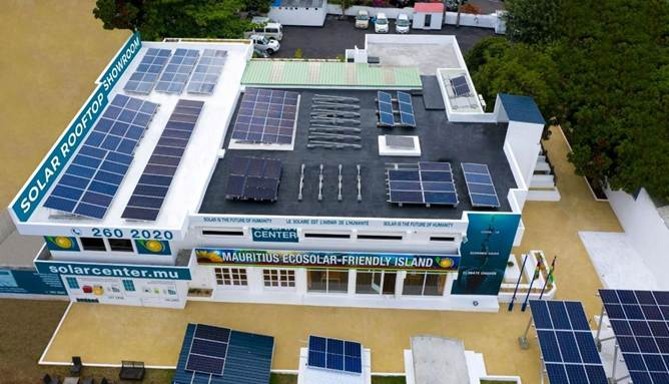
The government has made it clear that future investments will prioritize rooftop solar energy, a deliberate departure from large-scale solar farms on agricultural land, which are frequently opposed by farmers, environmental NGOs, and segments of the public. This pivot toward a distributed model is based on a simple yet powerful truth: every home, business, or school rooftop can become an autonomous energy hub, capable of producing, consuming, and storing its own electricity. According to joint estimates from the private sector and independent analysts, the country has an immediate potential of over 300,000 viable solar rooftops, representing a solar production capacity well beyond current national needs, especially when paired with smart storage solutions.
A Scientific Vision Validated a Decade Ago
In 2015, Dr. Dhirajsing Rughoo, a Mauritian electrical engineer and researcher, published a little-known study demonstrating that full national energy coverage was already feasible with just 160,000 solar rooftops equipped with individual batteries. His rigorous and realistic calculations showed that Mauritius could not only achieve energy independence, but also significantly reduce its national energy bill, external dependency, and CO₂ emissions, while fostering a distributed green economy rooted in local communities and a new generation of solar technicians. A vision perfectly aligned with that advocated by Jeremy Rifkin in his renowned book, “The Green New Deal”.
Challenges of Storage, Infrastructure, and Sovereignty
Achieving 60% renewable energy by 2035 and 100% by 2040, as reaffirmed in official government documents, requires more than just deploying solar panels. It demands a smart grid capable of managing intermittency, decentralized storage solutions (such as home or shared batteries), modernization of the national grid, and tailored financial incentives like solar leasing, low-cost rentals, or pay-as-you-go solar consumption.
A Decisive Financial Boost in 2025: AFD and Proparco Fuel the Green Transition
The year 2025 marks a major milestone in energy cooperation between France and Mauritius, with concrete and substantial financial commitments to the green transition. The French Development Agency (AFD), through its SUNREF program, has ramped up its support this year, consolidating a total envelope of over €175 million committed since 2009. These funds are now being actively redirected toward distributed solar projects, energy efficiency, and climate innovation, accelerating and scaling up sustainable investments. Meanwhile, Proparco, AFD’s private sector financing arm, made a pivotal move in 2025 by operationalizing a $120 million credit line (about €110 million) granted in late 2023 to Mauritius Commercial Bank (MCB). This line is now actively mobilized to finance residential, commercial, and industrial solar projects, as well as decentralized storage and climate adaptation solutions. The goal is to develop solar energy as a key driver of the United Nations Sustainable Development Goals (especially 1 and 2) and the European Union’s Green Deal (“Leave no one behind”). These funds arrive just as the Mauritian government launches its own MUR 30 billion public investment plan. The resulting public-private leverage effect paves the way for an unprecedented wave of investment in solar infrastructure, rooftop photovoltaics, technical training, and smart energy management solutions.
Solar Center: A Private Catalyst for Distributed Solar in Mauritius
Among the companies embodying this citizen-driven, decentralized solar vision, Solar Center Mauritius stands out as the undisputed leader in residential and commercial solar transition. Since 2010, the company has deployed turnkey photovoltaic solutions focused on self-consumption, individual storage, and intelligent energy management, perfectly aligned with the government’s new strategic direction. Present across the island, Solar Center anticipated the 2025 strategic shift by promoting rooftop installations over large-scale projects on sensitive land. This positioning makes it a central player in the operational rollout of the national green electrification policy.
Rejecting the Centralized Model on Agricultural Land
In contrast, the installation of massive solar farms on agricultural land raises numerous issues: loss of arable land, land disputes, production overconcentration, dependency on large operators, and growing public opposition. Distributed solar offers a low-impact, environmentally integrated alternative that respects agricultural land while accelerating decentralized energy production across towns and villages. This approach enjoys strong public support. A viral citizen petition, widely shared on social media (especially Facebook), garnered thousands of likes in just a few days to oppose industrial solar farms on productive farmland. This grassroots movement reflects Mauritians’ commitment to a local, environmentally respectful energy model.
A Globally Replicable Model
By betting on distributed solar, Mauritius is embracing a more resilient, equitable, and sustainable energy model. This sends a powerful message to other island nations and small developing countries facing similar structural challenges: limited space, energy dependency, and climate vulnerability. Massive state support, civil society mobilization, and the revival of pioneering technical research (like Dr. Rughoo’s) form a solid foundation to transform the island into a global showcase for inclusive energy transition.

In Summary:
- Budget Allocated: MUR 30 billion over 3 years (~€600M)
- Targets: 60% renewables by 2035, 100% by 2040
- Preferred Strategy: Distributed solar (residential, public, industrial rooftops)
- Estimated Potential: 300,000 installable solar rooftops
- Foundational Study: Dr. Dhirajsing Rughoo – 160,000 rooftops = energy autonomy
- Benefits: Energy independence, local jobs, carbon reduction, energy justice
- Rejected Model: Centralized solar farms on agricultural land
- Vision: Make Mauritius a regional hub and global model for distributed solar
- Key Actor: Solar Center Mauritius – residential solar leader aligned with national strategy
Find more about Solar Center Mauritius on their website http://www.solarcenter.mu/