How ClearCost MD Is Helping Small Businesses Reduce Healthcare Costs Without Traditional Insurance Barriers

ClearCost MD gives small businesses another way to support employee healthcare access while addressing rising healthcare costs.
For a small business owner, hiring another employee can represent growth. It can also introduce another difficult question: How can the company provide meaningful healthcare support without taking on costs that strain the business? As premiums, deductibles, and other healthcare expenses rise, that question has become increasingly important for entrepreneurs competing for talent while protecting limited operating budgets.
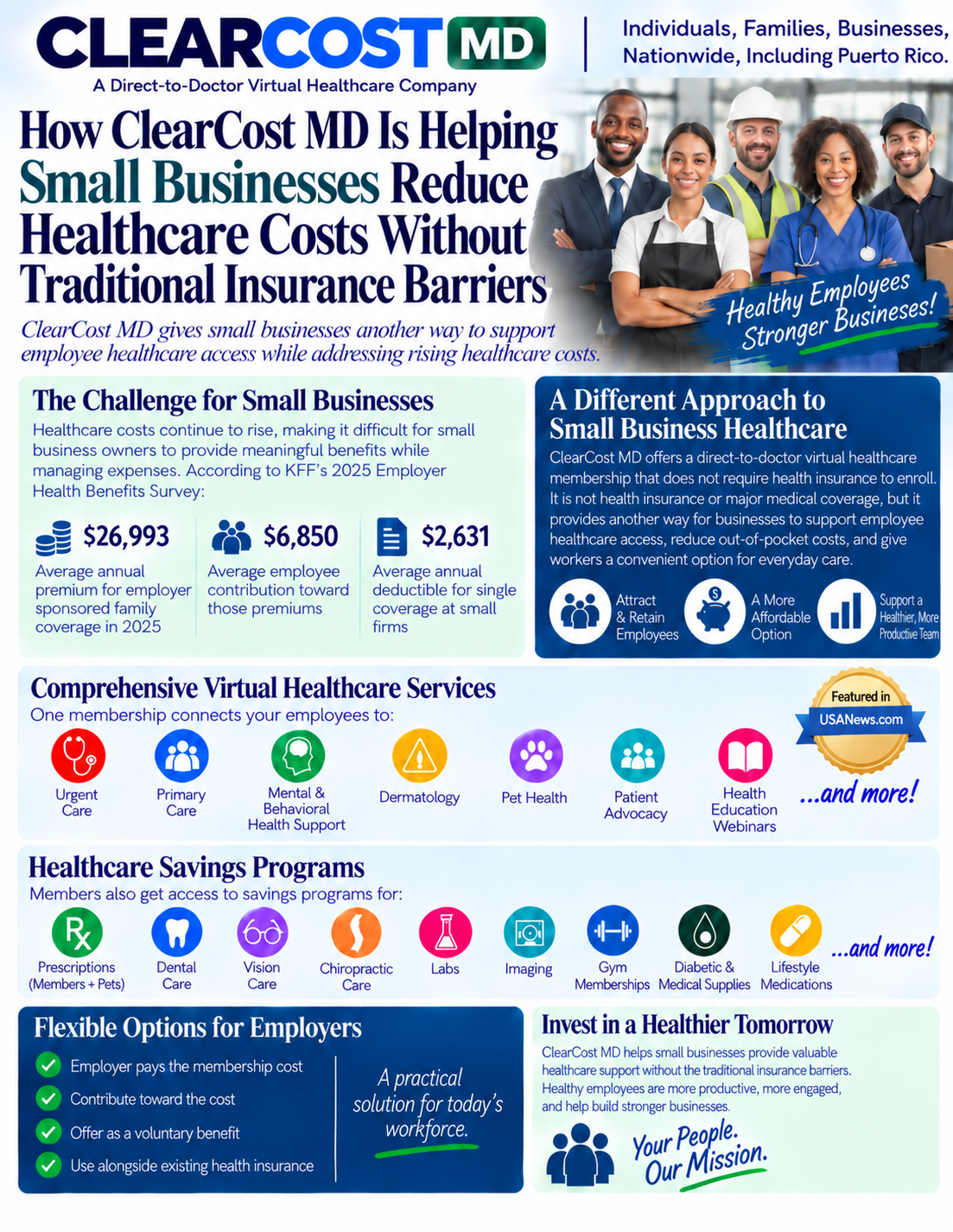
The pressure is measurable. According to KFF's 2025 Employer Health Benefits Survey, the average annual premium for employer sponsored family health coverage reached $26,993 in 2025. Workers contributed an average of $6,850 toward those premiums. For covered workers enrolled in plans with a general annual deductible, the average deductible for single coverage was $1,886. At smaller firms, it reached $2,631.
Those numbers highlight a challenge that extends beyond healthcare. For small companies, healthcare costs can influence hiring decisions, employee retention, compensation planning, and the ability to compete with larger employers. For workers, having insurance does not necessarily eliminate concerns about deductibles, copays, convenience, or other out of pocket expenses.
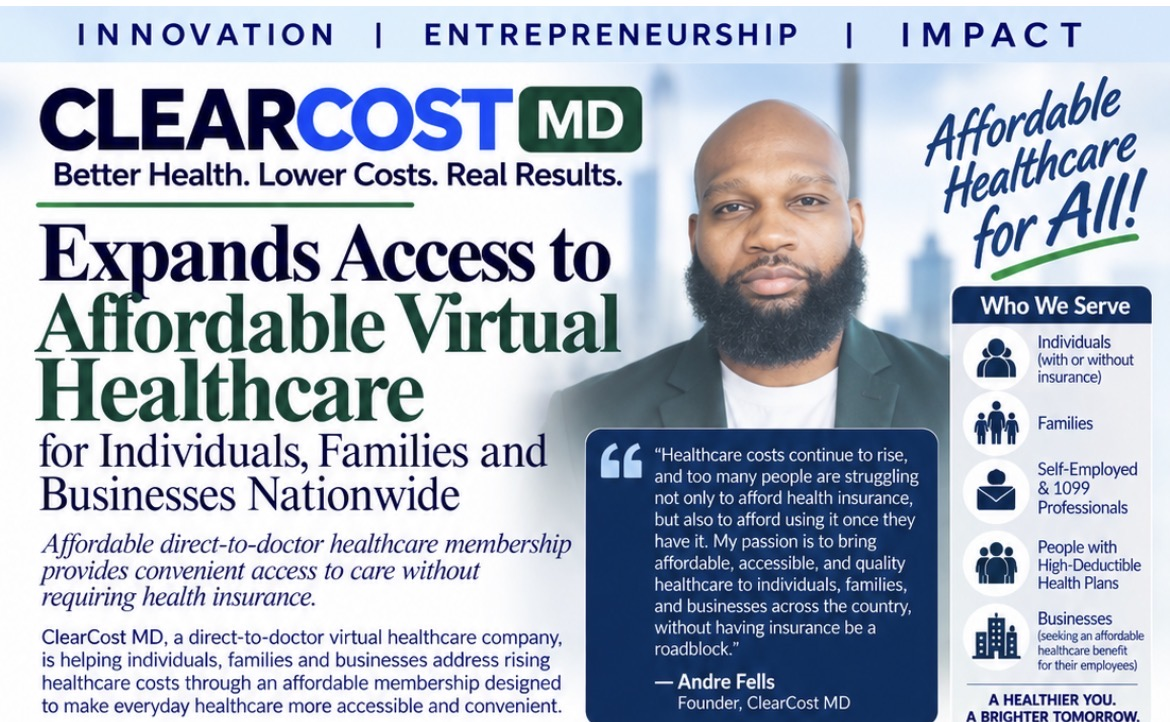
ClearCost MD founder Andre Fells believes businesses need more options.
ClearCost MD Approaches Small Business Healthcare From A Different Direction
Fells came to the problem after more than 14 years working across over 16 states in healthcare leadership roles such as Chief Growth Officer, National Sales Manager, and Regional Director of Growth and Business Development.
He spent approximately seven years of his career with Dedicated Senior Medical Center and JenCare under the ChenMed umbrella. During his most recent tenure there as Regional Director of Growth & Business Development (NC,SC,GA), he helped drive $13 million in new-market revenue in 2024, supported expansion across multiple states, and grew patient populations from launch to more than 7,000 in under three years.His experience on the provider side was complemented by years working with health insurance. A licensed Life and Health Insurance Advisor since 2014, Fells has experience with Medicare, Medicaid, and the Health Insurance Marketplace.
Seeing healthcare from both perspectives shaped the idea behind ClearCost MD.
Rather than trying to recreate traditional employer sponsored insurance, ClearCost MD offers a Direct-to-Doctor virtual healthcare membership that does not require health insurance to enroll. The model is designed to give individuals, families, and businesses another way to access eligible routine healthcare services.
For employers, that distinction is important.
ClearCost MD is not health insurance or major medical coverage, and it should not be viewed as a replacement for comprehensive insurance that covers hospitalization, surgery, emergency services, and other major medical needs. Instead, the company positions its membership as an additional healthcare access option that businesses can offer independently or alongside existing benefits to help offset rising healthcare costs through the traditional healthcare ecosystem.
Why Small Business Healthcare Costs Require New Options
Large corporations can often spread benefit expenses across substantial workforces and negotiate within established benefits structures. Small businesses frequently operate under different constraints.
Every recurring expense matters. At the same time, workers increasingly evaluate employers based on more than salary. Access to useful benefits can influence whether an employee joins a company, remains with it, or looks elsewhere.
This creates a difficult balance for founders and small business owners. They want to support their employees, but they also need predictable expenses and flexibility.
ClearCost MD is designed around that gap.
Businesses can make virtual healthcare memberships available to employees without requiring those employees to have insurance to enroll. According to the company, employers can pay the membership cost, contribute toward it, or make it available as a voluntary benefit. Companies that already provide traditional health insurance can also use the membership alongside existing coverage.
That flexibility can be relevant for companies with diverse workforces, including employees who have different insurance situations or who need more convenient access to routine healthcare.
ClearCost MD Recognized for Affordable Telehealth Access
ClearCost MD’s approach to accessible healthcare has earned recognition from BestofBestReview.com, which named the company the Best Affordable Telehealth Membership for Uninsured, Self-Employed, and Small Businesses in the US of 2026. The award reflects ClearCost MD’s focus on providing flexible, affordable virtual healthcare options for individuals and small businesses, including those who may face challenges with traditional insurance costs and structures. While the membership is not a replacement for comprehensive medical insurance, the recognition highlights the company’s efforts to provide another practical option for everyday healthcare access.
One Membership Connects Workers With Multiple Healthcare Resources
ClearCost MD's model extends beyond a single type of virtual doctor visit.
Depending on the applicable service and membership terms, members can access virtual urgent care, primary care, dermatology, mental and behavioral health services, patient advocacy, healthcare education, and additional virtual resources. Pet health services are also available through the platform.
Members can connect with licensed healthcare professionals remotely using a phone, tablet, or computer. That can reduce practical barriers associated with routine care, including travel and scheduling difficulties.
For employers, convenience can have business implications. An employee who can address an eligible routine healthcare need virtually may have more flexibility than someone who must arrange transportation and spend additional time traveling to and waiting at an office for care.
The company also provides access to healthcare savings programs covering eligible expenses such as prescriptions, dental services, vision care, chiropractic services, laboratory services, imaging, lifestyle medications, and other healthcare needs. These programs provide discounts rather than insurance benefits, and individual savings vary.
The combination reflects the central idea behind ClearCost MD: healthcare access and healthcare cost management do not necessarily have to begin and end with an insurance card.
Andre Fells Built ClearCost MD Around A Problem He Saw From Both Sides
Fells career provides an unusual perspective on the traditional healthcare challenge.
On the provider side, he saw how healthcare organizations work to expand access and serve patient populations. On the insurance side, he gained experience with the coverage structures consumers rely on to pay for care.
Those two perspectives led him toward a model focused on a different part of the equation: giving people another route to routine healthcare access.
That approach may be particularly relevant to entrepreneurs because small business owners often face the healthcare affordability problem twice. They must consider healthcare for themselves and their families while also deciding what, if anything, they can realistically provide to employees.
ClearCost MD is built to serve both sides of that challenge.
The membership can be used by people who already have insurance as an additional healthcare resource. It can also provide eligible virtual healthcare access to people who do not have insurance. That makes the model applicable to a broad workforce that can include small business employees, self employed professionals, freelancers, and independent contractors.
A Different Benefits Conversation For Small Business Owners
The future of employee benefits may not depend on finding one solution that handles every healthcare need. For some businesses, it may involve combining different tools to create a benefits strategy that better reflects the company's workforce and budget.
ClearCost MD is entering that conversation with a deliberately focused proposition.
It is not asking small businesses to treat virtual healthcare as a replacement for comprehensive medical insurance. Instead, it offers employers another option for helping workers access eligible everyday healthcare services while potentially providing additional savings opportunities.
For entrepreneurs competing against larger organizations for employees, that can change the benefits conversation. A smaller company may not have the same resources as a national corporation, but it can still explore practical ways to improve healthcare access for its workforce.
That is ultimately the business problem ClearCost MD is attempting to solve.
As healthcare costs continue to influence both household and company budgets, small employers will need to evaluate which benefits deliver meaningful value without creating unsustainable expenses. Models that emphasize virtual access, predictable membership structures, and flexibility may become an increasingly important part of those evaluations.
Small business owners and entrepreneurs interested in examining whether ClearCost MD fits their workforce can visit the ClearCost MD employer resource to review current membership options, services, limitations, and employer participation details. Additional information is available through the ClearCost MD website or by contacting Andre Fells at leadership@clearcostmd.com.
ClearCost Meds: Affordable Lifestyle Medications, Made Simple
With lifestyle medications such as GLP-1s becoming increasingly popular, Fells also created ClearCost Meds which is focused on making these high-demand treatment options more accessible, convenient, and affordable for people looking to take a more proactive approach to their health and wellness through a simple, convenient online platform. The service focuses on areas such as weight loss & management, hair growth, and other men’s and women’s health products, giving consumers another way to access select medications while helping reduce out-of-pocket costs. ClearCost Meds is built around convenience, transparency, and making lifestyle-focused treatment options easier to access. ClearCost Meds is available at ClearCostMeds.com

CEO Times Contributor
Covers business, innovation, and leadership, with a particular interest in entrepreneurs and emerging brands.
This article features partner, contributor, or branded content from a third party. Members of the CEO Times editorial staff were not involved in the creation of this content. All views and opinions are those of the contributor alone.