
Dmitry Borovoy of TruckerNavi: The Founder Who Wrote the Manual Small Trucking Companies Never Get


TruckerNavi founder Dmitry Borovoy helps new trucking companies navigate registration, safety compliance, and operational paperwork.
A new trucking company can begin with something simple: one truck, one owner, and a plan to find freight. But behind that truck sits a growing administrative responsibility. Driver files still need attention. Drug and alcohol program requirements still matter. Inspection records must be maintained. Registration requirements and filing deadlines do not disappear simply because the company has only one vehicle.
That gap between the simplicity of starting a trucking business and the complexity of operating a regulated carrier is where Dmitry Borovoy has built his work. Dmitry Borovoy is the founder of TruckerNavi and the author of the book Safety Manager. Through TruckerNavi, he helps new carriers with company formation, USDOT and MC authority, BOC-3, UCR, and ongoing safety compliance. The company serves clients in New York, New Jersey, Florida, and Illinois in Russian and English.
When One Truck Becomes A Regulated Business
For a new owner operator, the early days of a trucking company can feel focused almost entirely on freight. Finding loads, keeping the truck moving, and building a customer base naturally take attention. Yet regulatory obligations continue in the background.
Borovoy's work focuses on that less visible side of the business. TruckerNavi helps new carriers address the administrative steps involved in becoming and remaining compliant, including company formation, USDOT registration, MC authority, BOC-3, UCR, and ongoing safety compliance.
The company's slogan, "We are useful," reflects a practical philosophy. Instead of treating compliance as an abstract administrative exercise, TruckerNavi focuses on the documents, registrations, records, and deadlines that can affect a carrier's ability to operate.
As Borovoy puts it: "The first 90 days kill more new carriers than the freight market does: insurance lapses and paperwork timing, not cheap rates, are the number one authority killer."
The observation captures the problem Borovoy has chosen to address. A business can have freight waiting and a truck ready to move, but administrative gaps can create problems that have little to do with the freight itself.
Turning The Safety Manager Role Into A Book
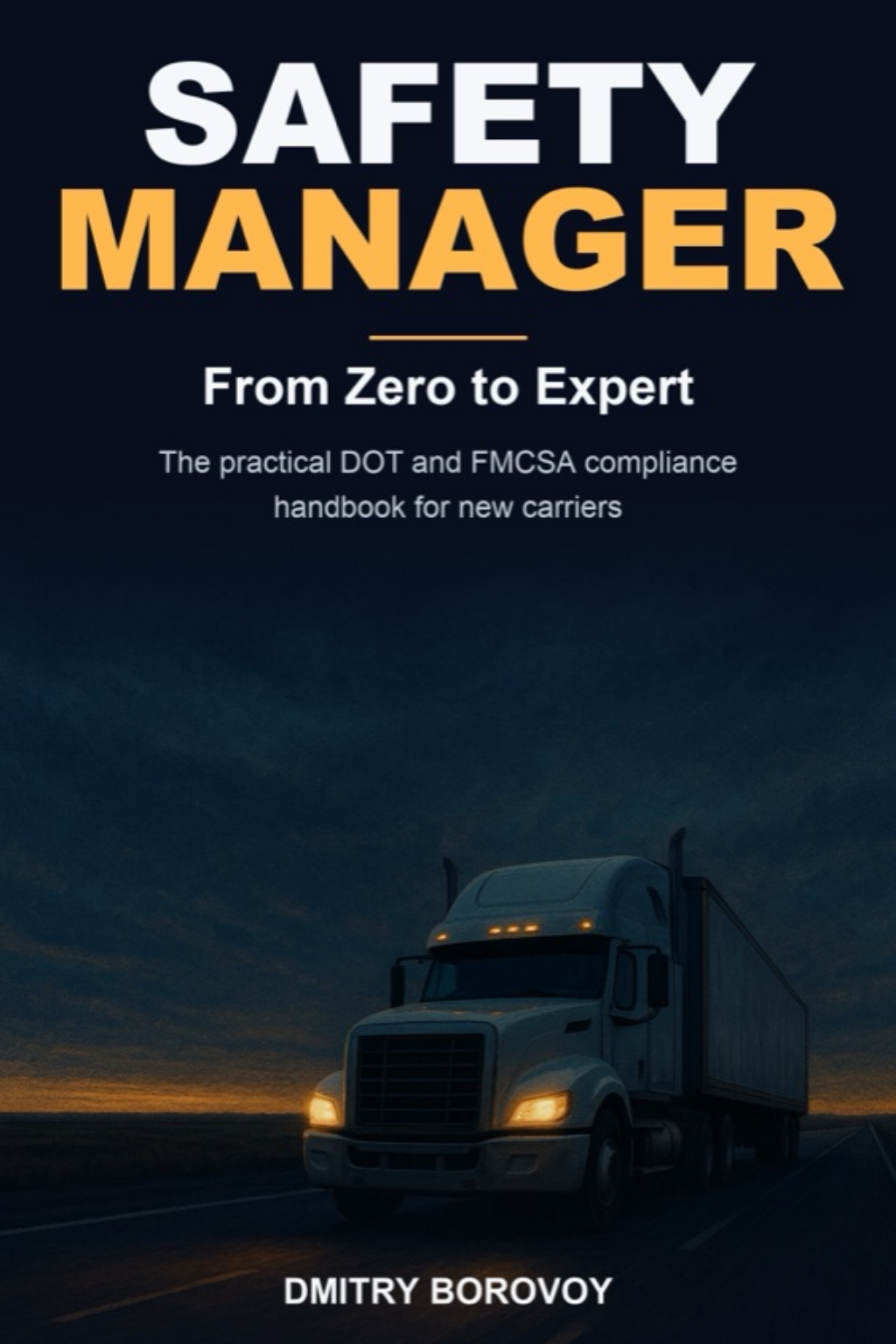
Borovoy extended that focus into publishing with Safety Manager: From Zero to Expert, a guide designed to explain the safety and compliance responsibilities inside a trucking company in plain language.
The book is available in Kindle, paperback, and hardcover formats on Amazon. Its paperback ISBN is 9798190095845. Rather than presenting the safety manager role as something reserved for large fleets, the book addresses the practical systems and organizational habits that can help trucking companies manage their responsibilities.
One example comes from its discussion of insurance policy renewals:
"Golden rule of renewal: new policy starts at 00:01 of the day the old one ends at 23:59. Gap = 0 seconds. Not minutes, not hours. Seconds."
The statement illustrates the book's broader approach. Compliance can depend on timing and documentation details that may appear small until they create a larger operational issue.
The book also emphasizes organization. Borovoy writes:
"One rule: one company, one folder. If the owner has two USDOT numbers, keep two separate Company Files. Don't mix them. Ever."
For a one truck owner handling many responsibilities personally, simple organizational rules can provide a practical structure for keeping company records separate and accessible.
Readers can find more information about Safety Manager: From Zero to Expert at TruckerNavi.
A New Book For The Motus Era

Borovoy has also written From SAFER to Motus, a guide to FMCSA registration after the agency moved to its new Motus system in May 2026.
Borovoy's second book is intended to help readers understand that change. From SAFER to Motus provides another practical resource for people working through the administrative side of operating a carrier.
More information about the book is available at TruckerNavi.
Looking At The Data Behind Pending Authority
Borovoy's work also extends into transportation data. In a working paper published on Zenodo, he reported that on September 20, 2026, 20,520 of 21,643 pending FMCSA operating authority records, or 94.8 percent, had no liability insurance filing on record.
His data work adds another dimension to his focus on carrier compliance. Instead of looking only at individual paperwork problems, he examines patterns within regulatory data to understand where carriers may encounter obstacles during the authority process.
The working paper is available through Zenodo.
Borovoy also wrote a data column on an earlier snapshot of the same FMCSA records for Commercial Carrier Journal, published on August 31, 2026.
Two Professional Paths With A Clear Separation
Separate from TruckerNavi, Borovoy is a New Jersey-licensed property and casualty insurance producer. His insurance practice is presented at SafeBridge Insurance.
That distinction is important because TruckerNavi itself does not sell insurance. Its focus is carrier registration and compliance services, while Borovoy's insurance practice is separate.
The separation reflects the different responsibilities involved in starting and maintaining a trucking business. Registration, authority, compliance records, and insurance requirements can intersect, but they are not the same function.
For new carriers, understanding those distinctions can make the administrative landscape easier to navigate.
Making Compliance Understandable For The One Truck Owner
Borovoy's work ultimately centers on a straightforward problem. Small trucking companies may have fewer people, fewer trucks, and fewer administrative resources than larger fleets, but their regulatory responsibilities do not simply shrink with the size of the operation.
A one truck owner may be the driver, business owner, dispatcher, and person responsible for administrative decisions. Creating systems for records, deadlines, registrations, and safety documentation therefore becomes part of building the business itself.
Through TruckerNavi and his books, Borovoy has built his professional focus around making that side of trucking easier to understand and manage.
For new and growing carriers looking for practical information about registration and compliance, TruckerNavi provides information about its services, while Safety Manager: From Zero to Expert and From SAFER to Motus extend that educational focus into book form.

CEO Times Contributor
Covers global markets, corporate finance, and the executive careers built on them.
This article features partner, contributor, or branded content from a third party. Members of the CEO Times editorial staff were not involved in the creation of this content. All views and opinions are those of the contributor alone.