
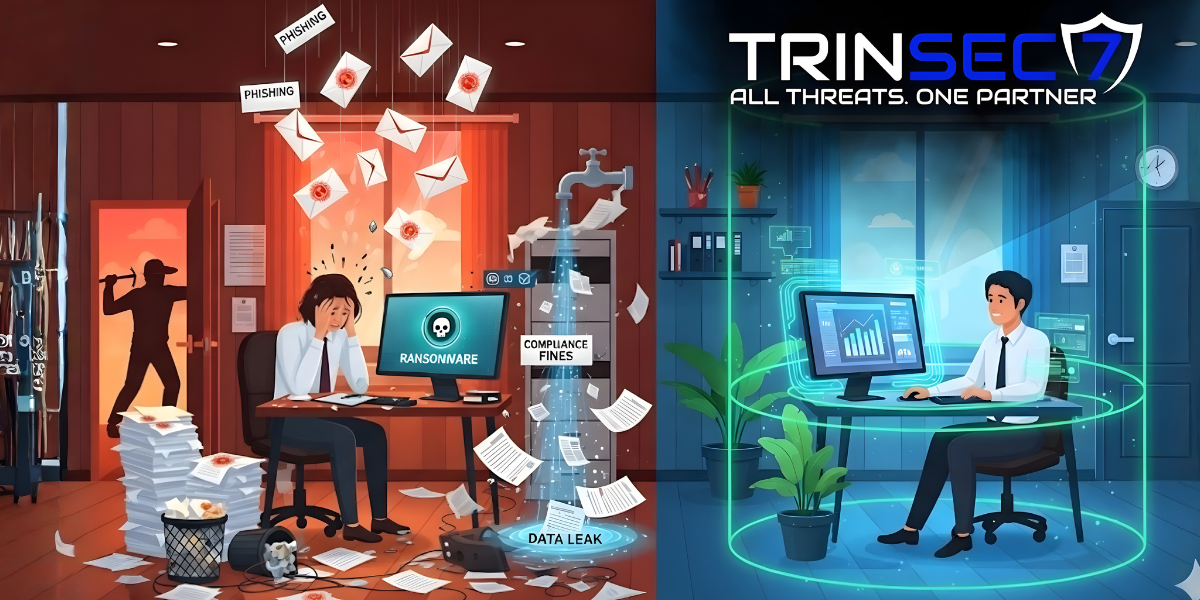
Most CEOs don’t think about security until it’s far too late. An employee clicks one bad link. A disgruntled insider quietly exfiltrates files. A malfunctioning camera misses the moment that changes everything. And suddenly, a seemingly small vulnerability becomes a million-dollar disaster.
For small and midsize businesses (SMBs), the risk is even more severe. Hackers intentionally target them. Regulators are tightening requirements. Insurance companies are denying claims. And the cost of doing security “the traditional way”—hiring a team, juggling vendors, building an internal program—is wildly out of reach.
Yet one company, TRINSEC 7, claims the entire problem is solvable.
Not with another camera.
Not with another tool subscription.
But with a holistic, done-for-you security department, delivered through a single partner.
To understand how TRINSEC 7 is changing the landscape, CEO Times sat down with its founder, George Hyek, a former federal law-enforcement agent and Army veteran whose unconventional approach is turning heads in the executive world.
Hyek opened our interview with a sentence that felt more like a punchline than a business insight:
“Ever feel like you have five security companies and zero security?”
Most CEOs laugh when they hear it—until they realize the truth behind it.
A typical SMB often has:
- A camera vendor
- An IT provider
- A cybersecurity tool
- A compliance consultant
- Maybe a guard company
And yet, there is no single leader responsible for the organization’s safety. Everything is siloed. Everyone has their own tools. No one owns the outcome.
“When something breaks,” Hyek tells us, “everyone blames everyone else. And the CEO—who has zero time for this—is left trying to figure out who’s lying and who’s responsible.”
It’s a broken model. And TRINSEC 7 was designed to replace it entirely. One of the most common myths Hyek encounters is the belief that IT equals security.
It doesn’t.
In fact, he argues, expecting IT to handle security is one of the biggest risk factors for SMBs.
“Your IT provider is drowning,” he says. “They’re keeping systems running, managing updates, solving employee tech issues, and putting out daily fires. They’re not staffed or trained to manage a modern security program.”
Hiring an internal security team isn’t realistic either.
A single cybersecurity engineer can cost $150–200k. A compliance manager adds another $120k. A CISO averages $250–350k.
Add physical security expertise, risk management, incident response, and AI threat detection, and the annual cost of building a real program easily exceeds $800,000.
“So SMBs try to assemble a patchwork of vendors,” Hyek explains. “But patchwork isn’t protection. It’s chaos.”
The Fractional CISO+ Model: Executive-Level Protection for SMBs
TRINSEC 7’s core service is something Hyek calls Fractional CISO+.
It’s fractional, but not in the traditional sense.
“A normal fractional CISO gives you advice,” Hyek says. “We give you leadership and execution. We don’t just tell you what needs to happen—we do it.”
It’s a full security department, delivering Hyek’s “7-Layers of Security.” It goes way beyond cybersecurity, even though that is a core tenant in every offering. He described how clients require different solutions, so they build custom programs for each one based on their needs. The programs can range from insider threat detection and response to hands-on active shooter training.
The best part is that the Fractional CISO+ service is only $150, per month, per seat. This is by design.
“Small businesses deserve real protection,” he says. “They just need a model that makes sense.”
To learn more about how TRINSEC 7 can help protect your business with cutting-edge, integrated security solutions, visit TRINSEC 7. Don’t wait for a security breach to disrupt your operations, take action now to ensure the safety of your business, your employees, and your reputation.
Related Links: