
An ambitious philosophical work reframes space exploration as a question of consciousness, identity, and the survival of meaning across the cosmos.
The future of humanity is often imagined in images. Rockets lifting through the atmosphere, colonies forming on distant planets. Artificial intelligence surveying distant star systems, autonomous fleets establishing colonies across foreign atmospheres, robotic infrastructure extracting resources on worlds no human foot has touched. These are the images that define the popular vision of progress and every one of them is external.
But space exploration cannot be separated from inward exploration. The outward journey is only half the equation. What type of civilization is expanding? What are the core values of the species behind the ships? What does it want to bring to the cosmos, and what guides it from within? Who will it become along the way? The familiar rhetoric “Let’s become a Type II civilization,” functions as a marketing language for corporate ambition and technological spectacle, but it says nothing about the consciousness of the civilization doing the reaching. Without that dimension, the entire conversation remains superficial. A species that cannot define itself inwardly has no coherent reason to expand outward.
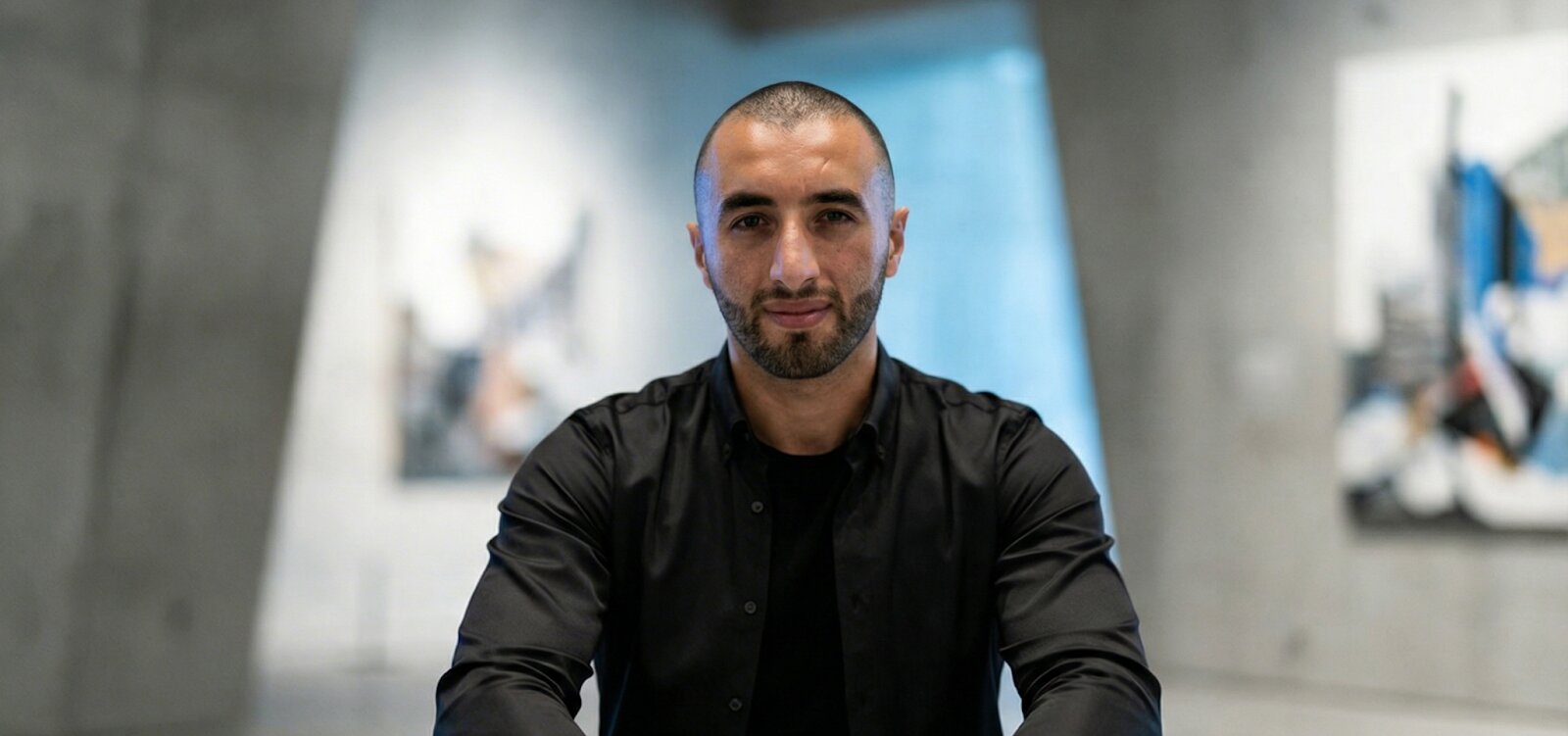
For Kaikhan Salakhov, the starting point was a question that no one seemed to be asking. Why is space exploration measured exclusively through external metrics energy output, territorial reach, technological capability? Why do we rely on human-centric models to gauge the progress of something that, by definition, extends beyond the human? And why is every existing framework entirely devoid of consciousness the inner development of a civilization as a whole?
That question became a seven-year research journey. The result is his 852-page work, Astral Space Exploration: The Cosmic Renaissance: The Fundamental Principles of Cosmocybernetics not a prediction of the future but the world’s first model of space exploration that integrates stages of consciousness into its structure. Developed alongside a solo exhibition at Firetti Contemporary, the project merges philosophy and visual art into a single system designed to expose the deepest contradictions behind human expansion into space.
Rather than asking what humanity will discover in the cosmos, Salakhov asks something more dangerous. What will it bring with it?
The Kardashev Problem
For over half a century, the Kardashev Scale has served as the dominant model for imagining civilizational progress. It measures advancement through a single axis: energy consumption. A Type I civilization harnesses its planet, a Type II its star, a Type III its galaxy. The framework shaped decades of scientific and popular thinking about what it means to evolve.
Yet Salakhov’s work exposes a fatal omission. The Kardashev Scale measures power but never asks what directs it. Awareness, ethics, meaning, and consciousness remain entirely unaccounted for and are treated as irrelevant to the question of advancement.
This absence, the book argues, is not theoretical. It is the defining danger.
A civilization that expands without evolving its consciousness does not leave its problems behind. It multiplies them. The same forces that generate conflict, inequality, and fragmentation on Earth do not dissolve in space. They scale across it. A species capable of stellar-scale energy extraction but governed by the same predatory logic is, in Salakhov’s formulation, a Type Two civilization with a Type Zero soul.
The ASX Grid
At the center of the project is the ASX Grid, a multidimensional framework designed as a direct alternative to the Kardashev Scale. Where Kardashev offers a ladder, the ASX Grid presents a diagnostic. It does not simply chart progress but reflects it back, forcing a confrontation between capability and intention.
The Astral Space Exploration Model of Consciousness maps dimensions that no prior model has attempted to unify: how many senses govern a civilization’s perception of reality, what stages and types of consciousness it operates through, what states that consciousness moves between, whether its dominant modes of thinking are linear or non-linear, whether its cognitive architecture assumes a self or no-self , whether its structures are hierarchical or decentralized and whether the civilization itself is biocentric, technocentric, biomechanical, or hybrid. Technology, in this system, is never neutral. It becomes an expression of the awareness directing it.
This shift transforms the meaning of advancement itself. Consider a species capable of harnessing the full energy output of its star a Type II civilization by every conventional measure. Now consider that this species is a xenophobic hive-mind that channels stellar energy into weapons of mass destruction aimed at the extinction of every other life form in its reach. By the Kardashev Scale, it is advanced. By any meaningful standard, it is not. Such a species cannot even comprehend the idea of interconnectedness or unity with other forms of life. Its entire trajectory is self-preservation through annihilation. Where, exactly, is the progress?
The gap is structural, and the ASX Grid exposes it. Genuine advancement is not measured by energy alone. It emerges when a civilization’s capacity for exploration matches the spiritual depth of its evolution when it surpasses species-centric egocentrism and moves toward a holistic interstellar expansion oriented not toward dominance but toward the benefit of all life forms it encounters.
Critically, the ASX Grid is non-anthropocentric. It does not assume human biology, cognition, or perception as the baseline. It is designed to accommodate xenocultural stages of consciousness, forms of intelligence and awareness that may operate through modes entirely unfamiliar to human experience, including synthetic, hybrid, and non-biological entities.
When Distance Becomes Division
The book’s most striking power lies in its questions. Not abstract speculation, but grounded scenarios rooted in physics, biology, and time.
What happens when two civilizations separated by light-years develop incompatible spiritual systems, and each message exchanged takes generations? What becomes of governance when decisions arrive centuries after the events they address? And how would cosmogeopolitics preserve holistic expansion and coexistence among colonies that have diverged into fundamentally different stellar ideologies from biocentric preservation to technocentric acceleration to biomechanical hybridization each with its own definition of progress, selfhood, and the purpose of existence itself?
These are not distant problems. They are built into the structure of interstellar space. The no-communication theorem and quantum decoherence ensure that no technological workaround, not even quantum entanglement, resolves the fundamental isolation imposed by distance.
Now layer biological divergence onto that isolation. A biocentric colony preserving organic evolution on a high-gravity world develops denser musculature, altered cardiovascular systems, shifted sensory thresholds and over millennia, a perceptual reality that no longer matches its origin species. A technocentric colony that has migrated its consciousness into synthetic substrates no longer ages, no longer reproduces organically, and no longer processes time the way biological beings do. A biomechanical hybrid colony merging neural tissue with quantum processors operates through modes of cognition that neither purely organic nor purely synthetic civilizations can parse. These are no longer cultural differences. They are ontological ones.
The further humanity travels, the less it may be able to remain coherent. Distance does not just separate locations. It separates realities, bodies, and minds.
The Role Of Art In A Technological Age
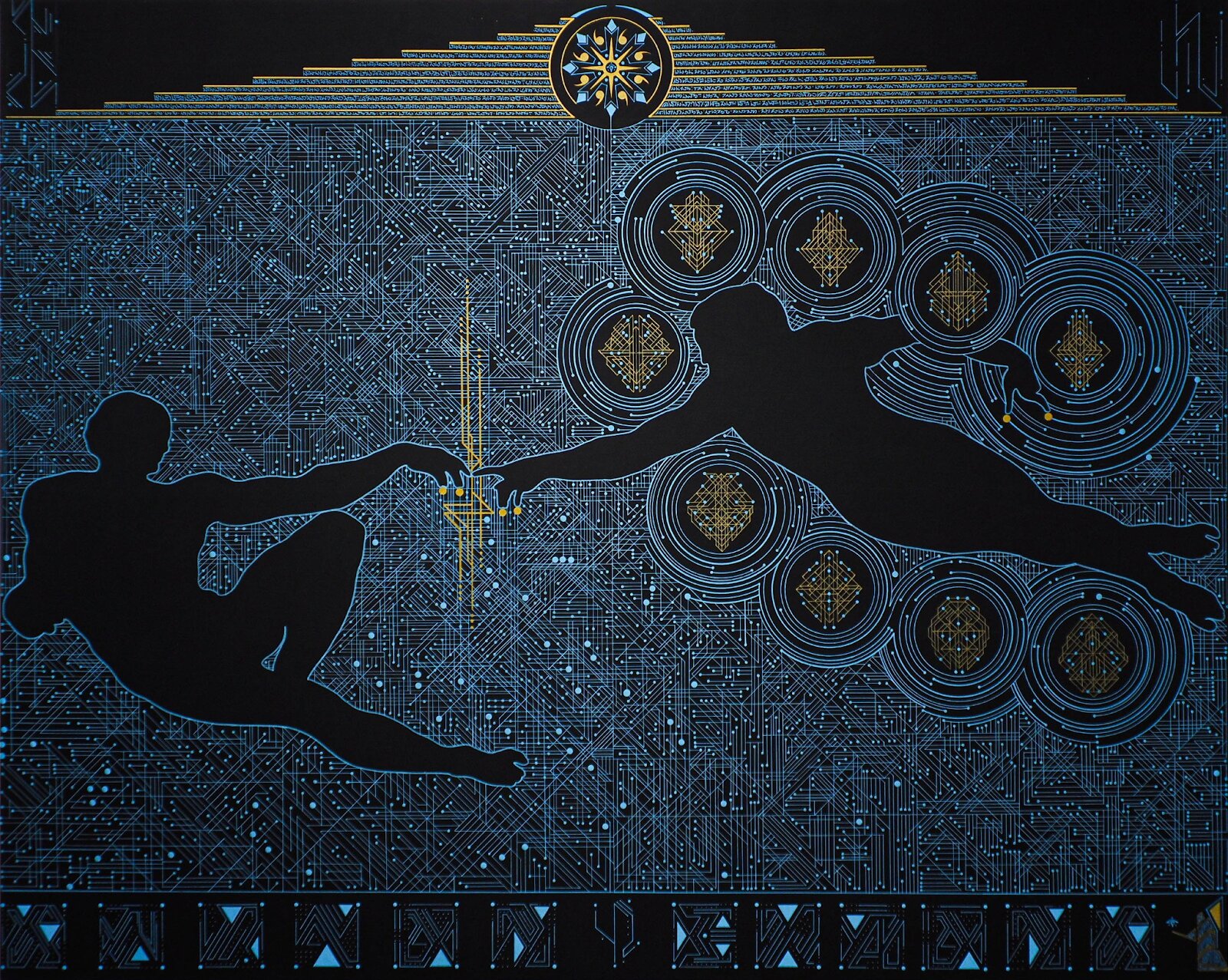
To explain and visualize the application of the ASX Grid, Salakhov created thirty-six paintings each one corresponding to a core principle of the model. Inspired by the Old Masters of the Renaissance, the works are produced entirely by hand: oil and acrylics on canvas, executed with compass and ruler in a technique that merges classical craft with futuristic geometry. The full body of work was exhibited in Dubai for several months, forming the visual dimension of the Cosmocybernetics project.
This choice of method is not aesthetic alone. It is conceptual. In a work that critically examines the role of technology, the refusal to use any digital or generative tools becomes part of the argument. The act of making remains grounded in physical intention and presence, set against the automation it interrogates.
The title The Cosmic Renaissance is itself a thesis. The Renaissance humanity needs for its interstellar future is not technological, it is within. The trip inward. The self-questioning that must precede any coherent expansion outward. Each painting translates this premise into geometric forms that suggest networks, flows of energy, and strata of consciousness not as decoration, but as a visual argument that the transformation of space exploration begins with the transformation of the explorer.
Discover The Astral Space Exploration Project
Those interested in exploring Astral Space Exploration: Cosmocybernetics can access the full work through its official platform at astralspacex.com. The complete book is available on Amazon at Amazon, offering direct access to the full text.
The exhibition and gallery representation can be viewed through Gallery: Firetti Contemporary, while the artist’s portfolio is available via Artsy. Additional insights into the creative process appear in a published feature at hube magazine interview, and ongoing updates can be followed on Instagram at Instagram.