

Luis Piza’s Functional Teams Training Program Shows How Leadership Structure Drives Success
When teams underperform, it’s common to attribute their failure to a lack of talent. However, leadership coach and consultant Luis Piza defies this assumption. With over a decade of experience in organizational development, Piza has seen firsthand that one-dimensional leadership in addition to dysfunctional relationships are often the real cause behind a team’s failure. According to Piza, teams do not fail due to insufficient talent, but because leadership and team dynamics have not been intentionally designed or developed.
The Hidden Problem: Dysfunctional Behaviors, Leadership and Competencies.
Many leaders mistakenly believe the solution to underperformance is simply pushing harder, demanding more effort or motivating their teams. But Piza’s approach challenges this mindset. In his Functional Teams Training Program, he explains that the problem isn’t motivation or lack of talent; it’s structure and interpersonal relationships. Most teams struggle because leadership is inconsistent, “leadercentric”, and/or teams actually behave as groups.
Piza asserts: “Motivation doesn’t fix dysfunctional teams. Structure does.” His work focuses on designing collaborative systems that promote vulnerability-based trust, situational leadership, and managerial soft-skills competencies. Piza transforms leadership from a personality-driven role into a strategic, operational model that encourages natural ownership across teams.
The program addresses issues such as unclear leadership styles, average to low proficiency managerial skills, and poor team dynamics that undermine performance. As Piza explains, “Most teams don’t fail because of lack of talent or commitment. They fail because they fail to address the issue from a strategy that considers situational leadership, functional teams and managerial competencies.”
The Shift from Managing People to Building Cohesive Teams
Unlike many leadership programs that emphasize personal charisma or motivational speaking, Piza works with executives and managers to build clear, functional systems that promote team cohesion and accountability. This approach not only improves team dynamics but also ensures decisions are based on clear strategies, not gut feelings or personal influence. Piza’s philosophy centers on the idea that leadership should never be improvised or driven by personality; it must be methodically designed and aligned with operational goals.
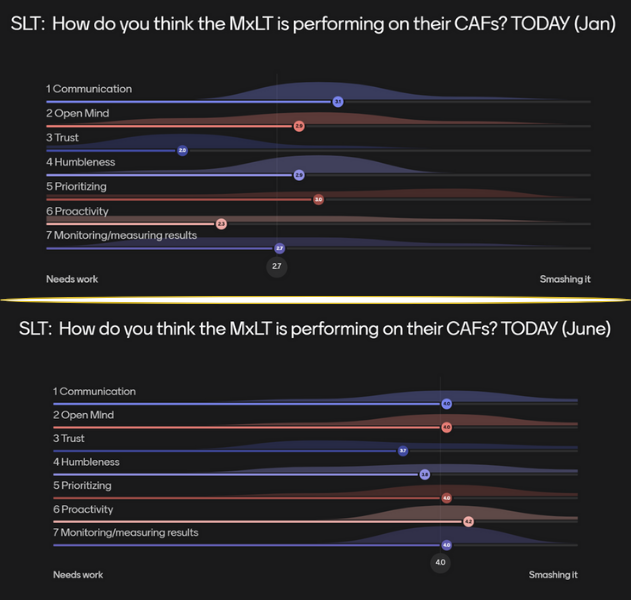 Image 1. The shift in perception from the Sponsor Leadership Team about the Mexico LT, January (2.7) to June (4.0).
This shift from controlling behavior to fostering responsibility is critical for sustainable growth. Piza integrates behavioral science with real-world application. His model is inspired by the Big Five Personality Model (OCEAN), Patrick Lencioni’s Five Dysfunctions of a Team, Leonardo Ravier’s General Theory of Coaching, and Hersey-Blanchard’s Situational Leadership which provides a scientifically backed framework for transforming team dynamics.
Situational Leadership: Developing Leaders Who Can Diagnose and Adapt
A central component of Piza’s methodology is the application of Situational Leadership, a model that equips leaders to accurately diagnose a team member’s readiness for a specific task—considering both competence and commitment—and to adjust their leadership style accordingly. Rather than applying a single preferred style, Piza trains managers to move intentionally between directing, persuading, participating, and delegating based on the employee’s developmental stage.
This diagnostic capability is essential for organizations seeking consistent, scalable leadership. Leaders learn to recognize when a collaborator needs structure and clarity, when they require support and influence, and when they are ready for shared decision-making or full autonomy. By teaching leaders to match their style to the maturity level of each individual, Piza helps eliminate misalignment, reduce friction, and accelerate performance.
Through this approach, leadership becomes neither authoritarian nor overly hands-off, but context-driven and adaptive, producing environments where people can grow and deliver results more effectively.
Functional Teams: Turning the Five Dysfunctions into Collective Strengths
Another foundational pillar of Piza’s work is the transformation of teams through Patrick Lencioni’s Five Dysfunctions of a Team. Using a combination of diagnostics, structured interventions, and practical team activities, Piza guides organizations in addressing the root causes of poor collaboration. His programs typically assess team functionality at the beginning, midpoint, and end of the engagement, allowing leaders to observe the evolution of trust, communication, and accountability.
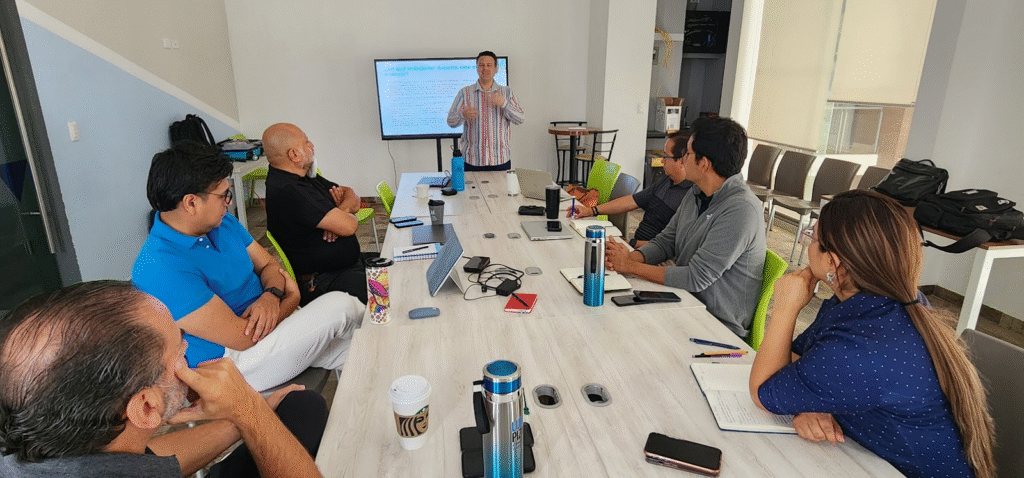 This model emphasizes that all functional transformation begins with vulnerability-based trust. Without it, teams tend to avoid productive conflict, hesitate to commit, resist accountability, and prioritize personal success over collective results. By designing experiences that foster openness, constructive debate, and aligned commitment, Piza helps teams convert dysfunctions into functional behaviors that support high performance.
This systematic approach enables leaders to build teams that are not only cohesive but also resilient, capable of making better decisions, managing conflict effectively, and delivering consistent outcomes
Developing Managerial Soft Skills: Building Tacit Competencies for Real-World Leadership
Beyond structure and diagnostics, Piza places significant emphasis on the development of managerial soft skills, recognizing that many of the behaviors that define effective leadership—communication, negotiation, planning, teamwork, and assertiveness—are fundamentally tacit. They cannot be transferred through lectures or traditional training alone; they must be cultivated through practice, reflection, and experiential learning.
Drawing on insights from Leonardo Ravier’s General Theory of Coaching and his own formal training in non-directive coaching, Piza creates learning environments where leaders refine these competencies organically. His programs move beyond theoretical instruction, helping leaders internalize new behaviors through non-directive discovery and real organizational challenges.
This tacit-development approach strengthens leaders’ ability to communicate with clarity, navigate conflict, influence without coercion, and make decisions with greater confidence. As a result, organizations see improvements not only in leadership effectiveness but also in cultural cohesion and strategic execution.
Empower Your Organization to Achieve Measurable Success
In an environment where teams face growing complexity and performance pressure, Luis Piza’s methodology offers organizations a structured and evidence-based path to improvement. By integrating situational leadership, functional team development, and the tacit growth of managerial competencies, Piza helps organizations address the behavioral, relational, and structural factors that most commonly undermine performance.
His programs move leaders from reactive management to intentional leadership design—where decisions are grounded in clarity, diagnostics, and collaborative systems rather than personality or improvisation. Organizations that adopt this approach consistently report stronger alignment, greater accountability, healthier team dynamics, and improved execution across functions.
Whether supporting leadership teams in Mexico, the United States, or internationally, Piza’s framework adapts to diverse cultural contexts while maintaining a singular focus: helping organizations build leaders and teams capable of sustained, measurable performance.
To learn more about how Luis Piza can help your team reach its potential, visit www.luispiza.com or connect with him on LinkedIn. You can also watch a video about his approach here.
Luis Piza’s Functional Teams Training Program challenges the leadership myth that teams fail due to lack of talent, offering practical solutions for long-term success.