
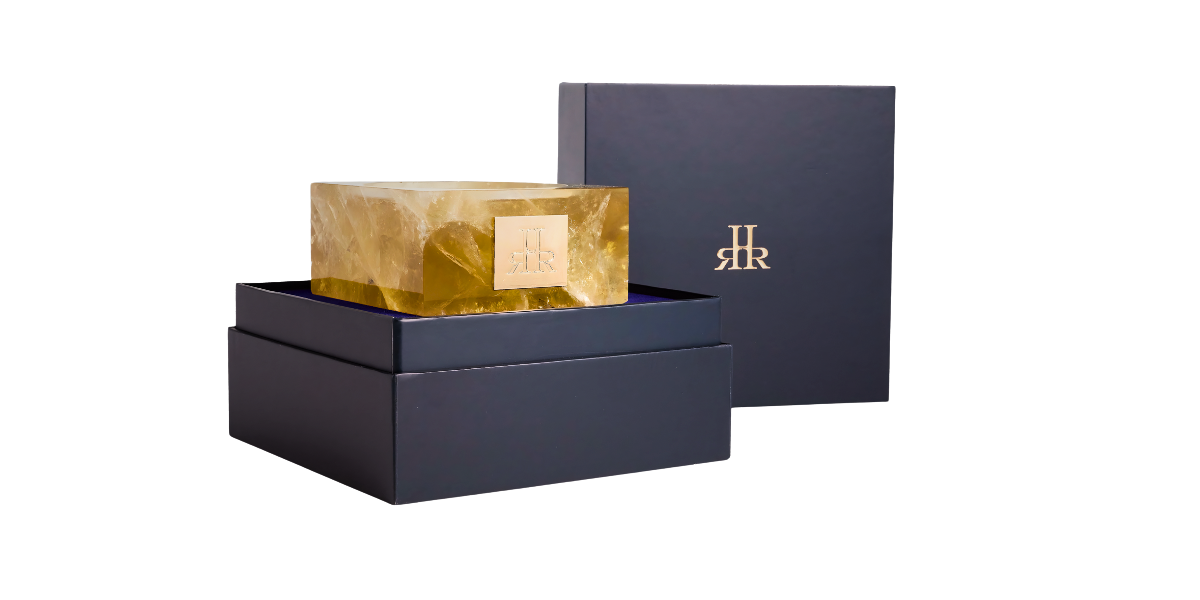
We recently caught up with Riccardo Halac-Ruggeroni, Founder and CEO of a luxury home fragrance brand that may be one of the best-kept secrets in the highly competitive industry.
RHR Luxury is the first luxury home fragrance house to offer authorship in niche perfumery, presented in luxurious crystal vessels. Defying the market paradigm of mass production and generic functional fragrancing, Riccardo, the house founder, is also the master perfumer, responsible for conceptualizing and creating all in-house fragrances. Aesthetically anchored in Italian Mid-Century Modern design, purist forms interpreted in luxurious materials encapsulate niche perfumery for the home, elevating the simple act of lighting a candle into a surrounding fragrance experience.
Inspired by the expansion of global trade during the Age of Discoveries, RHR Luxury explores the globalization of exotic materials within the context of mass migrations and the intermingling of cultures, and how this directly influenced the birth of modern perfumery as we know it today. Applied to luxury home fragrance, rare botanicals from all continents blend with the latest technology in molecular aromatic chemistry. Boldly combining the new and the millenary, intertwining historical and geographical references, RHR Luxury elegantly captures fragrance in space and time.
Riccardo Halac-Ruggeroni is the perfumer behind RHR Luxury. With a career spanning ten years in interior design and twenty in fashion, a lifetime sensitivity to perfumery gave shape to a body of work he realized as a late bloomer. Fluent in five languages, pragmatic and obsessive about details, Riccardo constructs perfumery accords with the scientific precision required for functional, ambient fragrance, elegantly sprinkled with the savoir-faire of a Grasse nose. A classical education in decorative arts is evident in his choice of materials, where an eye for purist lines permeates the elements of design in his collections. To experience his candles is an invitation to dwell in his world of impossibles turned everyday luxuries.
Defying conventional norms in the home fragrance industry, Riccardo arrived at it from a non-traditional background, having spent five years in research and development before launching his brand. Riccardo never held a job in the perfumery industry but realized that if he wanted to create one-of-a-kind fragrances for his line, he would have to dive deep into chemistry, biochemistry, botany, and the technical aspects of fragrance product development, as well as the practical steps behind pouring candles.
The home fragrance industry is a multibillion-dollar business, expected to reach $4.6 billion by 2030 in the U.S. alone. The main workhorse of the industry is scented candles. With an estimated 780 million candles poured per year in the U.S. alone, it’s no surprise that it is an automated process that relies on pre-blended fragrance manufactured in millions of liters each year. It’s easy to understand how fragrances from different candle brands all start to smell similar when you finally find them in a store.
 “If you want to launch a new business, what is your P.O.V., your Point Of View?” says Riccardo. “It’s easy to align yourself with an existing model, tried and proven, in which all the components of a scented candle are available, and the fragrance is readily available too.” But the challenge of any new brand entering the market is how to differentiate itself from the competition. The industry offers a myriad of options for candle containers, and there is a large market of private label companies that will create a complete product for you; all you have to do is stamp your name on it.
“That is the easy route,” he says. “The challenge for me was to think outside the box because I did not want to do the same as others have done. The market is saturated with products falling into the same mold: ceramic or soda glass tumblers, spray-painted, paper labels, and foldable boxes. To the customer, it all looks the same. As a customer, over and over, I’d walk away from stores with empty hands, not finding a connection with any brand in particular. I believe this type of product is an emotional purchase; there’s got to be a level of engagement, identification with a brand story, a meaning; otherwise, how do you engage?”
An integral part of the story behind RHR Luxury was to bring the development of fragrances in-house. “I felt it was the only way to step outside the mold and offer authenticity. Of course, I had to study perfumery on my own for years. Perfumery demands a high investment in materials; you can’t just learn the theory; you must apply it by blending the materials in order to smell the results and seriously dive into the periodic reformulation of blends, which is the work that perfumers do every day.”
Not long ago, during a different interview, he was told he was an outlier CEO. “Maybe, in the sense that as a CEO, I don’t just run the day-to-day operations of my small business, but I am also the creative head behind each product, and the creative nose behind each fragrance. The CEO title feels so large! I prefer to call myself a perfumer-in-training,” he says. Riccardo doesn’t believe in self-promotion; in fact, it took a few weeks to convince him to do this interview. He also doesn’t believe in online advertising. “I see a lot of redundancy. Hundreds of brands are vying for an additional three seconds of attention, and AI-inundated visuals turn it all into disconnected scrolling.”
RHR Luxury recently entered the European market through a sophisticated company called Scentissime, an ultra-niche platform showcasing niche perfumery from around the world. These independent brands are characterized by small product runs, many of them never repeated, the use of rare perfumery materials, and mostly run by perfumers who created their own brands. “It works for me, it’s a platform created for a discerning clientele who understands that pouring 1 million perfume bottles or 100,000 scented candles per year is not real luxury, it’s just an assembly line. So I question what the purpose is behind it all. Perfumery is a rare combination of craft, science, and art,” he says. “One thing is to make it accessible, and another is to plan world domination. The purpose becomes something else. Nothing against it, but how do you maintain quality standards? And how do you remain loyal to the craft when the fragrance for your products arrives by the truckload?”
 Another aspect of the industry is its heavy reliance on social media and collaboration with influencers, tools that Riccardo prefers not to use at the moment. “My Instagram page hovers around 2,200 followers, and every day I acquire one or two more. I never obsessed over it. You may think I am unseen, but not needing followers to define my brand’s success frees me from the bonds of current trends. It frees me to do what I want,” he confides. “If I am constantly looking for new inspiration, I think my potential new customers are too. And I definitely don’t find that inspiration in the posts of the usual suspects, the brands that have saturated the market.” His approach may be aligned with the times, where the new flex is to have no followers at all, to use social media as a medium for expression, not self-promotion.
“I post when I launch new fragrances or talk about the materials I use in my blends. People loved discovering essential oils a decade ago; I take this a step further into the rarified realm of absolutes, CO2 extractions, co-distillations, resinoids, and concretes, and explain how I use them, how they can define a fragrance with just a trace of the material. I sometimes share what’s going on in my garden, changing with the seasons, or what I have going on that day. It’s more organic; I post whenever I feel like I have something to share with the people who follow me. In a sense, I don’t need the algorithm to prove that I exist.”
As social media evolves into a platform for sales, with AI and visuals becoming manufactured, remaining discreet suddenly looks like having good taste. A large number of followers can mean bots, and it can also look outdated, harking back to an earlier symbol of success. In comparison, small looks authentic; it looks real.
“I derive satisfaction from a returning customer who bought from me a year or two ago. It’s the type of influence that is built one brick at a time, based on real results. Let’s remember that despite creating beautiful objects, my focus is also on functionality. Lighting a candle is a very intimate moment that can carry different meanings; it’s a time for yourself, a pause, an invitation to being in the moment.”
Follow RHR Luxury on Social Media:
